

Guide · updated October 2026
In summer you see cooling vests everywhere: on building sites, in motorsport, on the bike. Liquid Ice is not a vest. It is a liquid you spray onto clothing or soak into bands and bandages. Both cool the skin. Which one fits depends on where you want to cool, for how long, and what you have to hand.
Types of cooling vest
Cooling vests work on three principles:
- Evaporative vests are dipped in water, one to two minutes at one maker, and cool while the water evaporates. They need moving air, and you feel some dampness.
- PCM vests carry inserts of phase-change material that melts at a fixed temperature, 14 °C at one maker. The inserts are charged in a fridge, freezer or ice water, in about 30 minutes at that maker, and last up to three hours.
- Ice and gel vests hold frozen packs from the freezer. They cool hard but weigh more, and a long shift needs spare packs.
How Liquid Ice cools
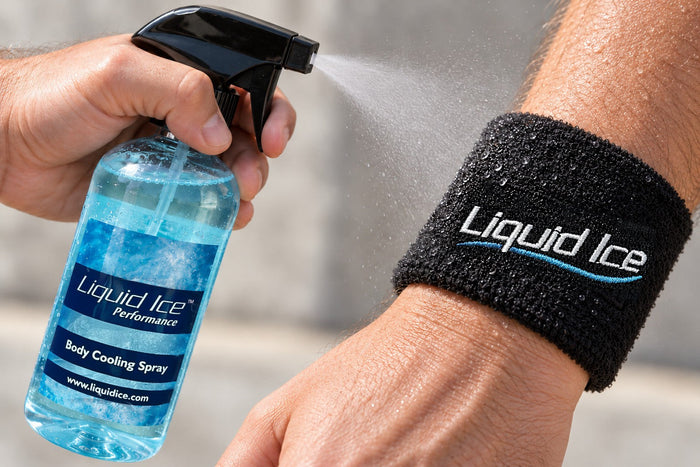
Liquid Ice is a ready-to-use liquid. You spray it generously onto a tight shirt, a jersey or a wristband, or soak a bandage or a band in it. As it evaporates, it takes heat away from the skin. That is the same physics as an evaporative vest, just without a tap: the bottle goes wherever you go.
Measured on the soaked bandage: 5.8 °C cooler skin. Still cooling after two hours.¹ Sprayed onto a shirt, Liquid Ice cools as long as the fabric is damp. When it warms up, spray again.
When a cooling vest is the better choice
For the whole upper body over many hours, a vest carries more cooling than a bottle or a band: it holds far more water or stored cold. If you do heavy work in the sun for hours and have a tap or a fridge nearby, a vest serves you well.
When Liquid Ice is the better choice
- Where a vest doesn’t reach: neck, arms, wrists, undershirt, knee and ankle.
- No tap, no freezer: the bottle is ready at room temperature, at the sideline as on the building site.
- On the clothes you already wear: no extra garment, nothing to charge.
- With compression: soaked in the can, the bandage puts cooling and compression into one bandage.
- Right away: spray it on and it cools.
Both together
The two don’t exclude each other: the vest for the upper body, Liquid Ice for neck, arms and wrists. A generous spray on the wristband or collar cools where the vest stops.
What research says about cooling the head and neck
A 2025 review of 63 studies on cooling the head, face and neck came to a clear result: the skin at the cooled spot gets cooler, and thermal sensation and comfort improve. Cooling in the right place mainly makes heat easier to bear.
Sources
- Stevens CJ et al., Int J Sports Physiol Perform 2025;20(6):743–763: review of 63 studies on cooling the head, face and neck. PubMed
- Maker information on evaporative and PCM vests (soak time, melt temperature, charge time, cooling time), read in October 2026.
- Skin temperature under the soaked bandage: Dermatest GmbH, Münster, 2008, 20 people. See the protocol
