

Heat protection at work: duties, plan and cooling for your crew
Austria's Heat Protection Ordinance, Germany's ASR A3.5 and ASTA recommendation: what companies must do, what belongs in a heat protection plan and where Liquid Ice fits in.

Since 1 January 2026, Austria's Heat Protection Ordinance (Hitzeschutzverordnung) has been in force. In Germany, ASR A3.5 and a recommendation of the Committee for Workplaces (ASTA) set out when companies should and must act on heat at work. This article covers what the law requires, what belongs in a heat protection plan and where Liquid Ice fits in: as one measure among several, not as a substitute for shade, water and breaks.
What the law requires
Austria: Heat Protection Ordinance for outdoor work in the heat
-
Reference: Hitzeschutzverordnung (Hitze-V), BGBl. II No. 325/2025, in force since 1 January 2026.
-
Scope: outdoor work at workplaces, on construction sites and at external work locations with solar heat or UV radiation. Work of short duration is exempt.
-
Trigger: a heat warning from GeoSphere Austria at level 2 or above (caution, yellow). That corresponds to a felt temperature of 30 to 34 °C.
-
Heat protection plan: the employer assesses the hazards (workload, duration, clothing and PPE, acclimatisation, people at particular risk), sets out a programme of measures including emergency measures, and involves the employees. The plan must be accessible to all employees and to the labour inspectorate, on paper or electronically.
-
Measures under the ordinance: first, avoiding the hazard, for example by moving working hours; then technical measures (“shading of workplaces, water misting and spraying, shower facilities”), organisational and personal measures, including “cooling clothing” and drinking enough.
-
Also: drinking water at external work locations too, UV-protective clothing, instruction, crane cabs that can be cooled (existing ones from 1 June 2027) and air conditioning in newly purchased self-propelled work equipment on construction sites.
-
Agriculture and forestry: a separate LF-Hitze-V, BGBl. II No. 45/2026, with the same trigger.
-
Municipalities: for employees of the federal states and municipalities outside of enterprises, the ASchG does not apply, and so neither does the Hitze-V. Check the protection rules that apply to your office.
-
Indoors: § 28 AStV sets 19 to 25 °C for light and 18 to 24 °C for normal physical work. Without air conditioning, other ways of lowering the temperature must be used to the full in summer.
-
Construction: hours above 32.5 °C in the shade count as bad weather. Whether work stops is decided by the company after consulting the works council. Employees receive 60 % of their wages, and the BUAK reimburses the company.
Germany: risk assessment, ASR A3.5 and the ASTA recommendation
-
Basic duty: every employer assesses the risks, including heat, derives measures and documents this before work begins. This also applies to municipal offices.
-
Workrooms (ASR A3.5): the air temperature should not exceed 26 °C. Above 26 °C measures should, and above 30 °C they must, take effect, technical and organisational before personal ones, and drinks must be provided. Above 35 °C, a room without measures such as those used for hot work, for example air showers or water curtains, is not a suitable workroom.
-
Outdoor work (ASTA heat recommendation of 21.08.2025): the yardstick is the assessment temperature: air temperature plus additions for heavy work (+4 °C), protective clothing with PPE (+3 to +4 °C), full sun (+5 °C) and humidity (+3 °C), minus wind (−2 to −3 °C). Above 26 °C measures should, and above 30 °C they must, take effect; above 35 °C the work is to be treated like hot work. Example: 29 °C air, heavy work and full sun make 38 °C. ASR A5.1 refers to this recommendation for heat; it does not carry the presumption of conformity that an ASR does.
-
Construction sites: drinking water or another non-alcoholic drink must always be available near the workplaces.
Heat protection plan: a 10-point checklist
Ten points that belong in every heat protection plan, for Austria and Germany:
-
Name who is responsible: who checks warnings, implements measures and monitors them.
-
Record the tasks: workload, sun exposure, clothing and PPE, heat sources such as asphalt or excavation pits.
-
Know who is at particular risk: older workers, pregnant workers, people with pre-existing conditions, new starters and people returning to work.
-
Set triggers and check them daily: in Austria heat warning level 2, in Germany 26, 30 and 35 °C.
-
Organise shade: sun sails, tents, cool break areas.
-
Move heavy work to the morning, rotate tasks, plan short cool-down breaks.
-
Provide drinking water close to the workplace and plan fixed drinking breaks.
-
Plan acclimatisation: increase the workload over 7 to 14 days.
-
Personal equipment: head and neck protection, UV clothing, cooling clothing such as cooling vests, cooling towels or a dampened neck guard.
-
Set the emergency procedure, give instruction, make the plan accessible, and after the summer check what worked.
Measures against heat at work
Both countries set the order: first avoid the hazard, then technical, then organisational, personal last. In Austria this is the STOP principle, in Germany the TOP principle. In practice, it takes a combination.
Technical
Sun sails and tents, water misters and air showers, fans, cooled break containers and cabins, showers.
Organisational
Heavy work in the morning, lifting aids, task rotation, many short breaks in the shade, drinking breaks, acclimatisation, no lone working.
Personal
Drink regularly, airy UV-protective clothing, helmet with neck protection, sunglasses, sun protection and cooling clothing. This is where Liquid Ice comes in.
Heat protection on the construction site, in the warehouse and at the depot: where Liquid Ice fits in
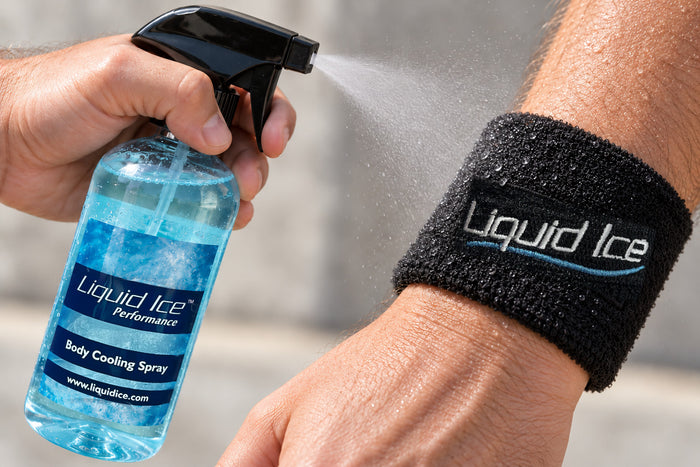
Liquid Ice is a cooling liquid that cools by evaporation. You spray it on tight-fitting clothing such as a shirt or headband, straight from the warm bottle. Or you wear it in pre-soaked bands and bandages: as a thin band under the helmet, as long as the helmet still sits properly, or as a bandage on the wrist. Measured: 5.8 °C cooler skin. Still cooling after two hours. (Dermatest GmbH, Münster · 20 subjects · measured on the soaked bandage)
Cooling with water and damp textiles is already in the rules: the Heat Protection Ordinance names water misting, spraying and cooling clothing, the labour inspectorate names cooling neck towels, the ASTA recommendation the dampened neck guard. Liquid Ice brings evaporative cooling to the textiles your people already wear.
For whole crews there is Liquid Ice in 25 litre canisters. From them you fill spray bottles and re-spray bands, on the construction site, in the warehouse or at the depot. No power, no ice, no fridge. A Lamborghini Super Trofeo team uses the 25-litre canister trackside for drivers and crew, and the US Marines rated Liquid Ice 9.1 out of 10 in a field test. Liquid Ice is made in Austria.
What Liquid Ice is not: a substitute for shade, drinking water, breaks and an emergency plan, or proof that your company complies with the ordinance. It is a personal measure that you list in your risk assessment alongside the others.
Common questions about heat protection at work
At what temperature does the employer have to act on heat?
In Austria, for outdoor work, from heat warning level 2 of GeoSphere Austria, which is a felt 30 to 34 °C. In Germany, measures should take effect above 26 °C and must above 30 °C, indoors based on air temperature (ASR A3.5), outdoors based on the assessment temperature (ASTA recommendation).
Is a heat protection plan mandatory?
In Austria, yes, for outdoor work: a programme of measures including emergency measures that employees and the labour inspectorate can see. In Germany, the documented risk assessment is mandatory. The ASTA recommendation suggests publishing its results as the company's heat protection plan.
Is there a heat day off on construction sites?
In Austria, hours above 32.5 °C in the shade count as bad weather. Whether work stops is decided by the company after consulting the works council; employees receive 60 % of their wages, and the BUAK reimburses the company. In Germany, ASR A3.5 and the ASTA recommendation set no temperature at which work automatically stops. Above 35 °C, measures like those for hot work are needed.
What counts as cooling clothing, for example a cooling vest for work?
The labour inspectorate names cooling vests, cooling caps and cooling neck towels, and its checklist also cooling towels. The ASTA recommendation lists cooling vests and headwear with a dampened neck guard. In both countries, personal measures come after technical and organisational ones.
Does Liquid Ice satisfy the Heat Protection Ordinance?
No, no single product satisfies the ordinance. What is mandatory is assessing the hazards and a plan with several measures. Within that, Liquid Ice is a personal measure: a cooling liquid that cools by evaporation on clothing, a band or a bandage. Measured: 5.8 °C cooler skin. Still cooling after two hours. Water, shade and breaks stay mandatory.
How do you supply a whole crew?
With the canister: 25 litres, from which spray bottles are filled and bands re-sprayed. It cools straight from the warm bottle, without power. You receive the terms in writing after a short call.
Cooling for your crew
Tell us how many people work in the heat at your company. We call you, go through canisters, bottles and bands for your heat protection plan, and send you the terms in writing after the call. Book a callback · More on the measurement: the proof.
