
Cooling spray, cold spray or cooling liquid? The difference
Three products, one principle: evaporation. What is in the can, what is in the mist, and why Liquid Ice belongs on fabric.
Cold spray (freeze spray) is liquefied gas in an aerosol can: it vaporizes instantly and sharply chills a small spot for seconds. “Cooling spray” can mean that, or a body mist of water, alcohol and menthol. A cooling liquid like Liquid Ice goes on a shirt, wristband or bandage and cools your skin as it slowly evaporates.
One search term, three products
Search for “cooling spray” and you get three things that have little in common: cold spray in a pressurized can, refreshing body mists, and cooling liquids that go on fabric. All three work on the same principle. A liquid evaporates and takes heat with it. What differs is what evaporates, how fast, and where.
Evaporating one kilogram of water at 37 °C (98.6 °F) takes about 2,430 kilojoules. Much of that energy comes from the surface the water sits on. For sweat, that surface is your skin, which is why sweating cools you.
Cold spray and freeze spray: liquefied gas in a can
Cold spray, also called freeze spray or ice spray, is a liquefied gas in an aerosol can, usually butane and propane. Inside the can it is under pressure and stays liquid. Once it leaves the nozzle it vaporizes instantly and pulls heat from whatever it hits. The spray typically reaches −25 to −55 °C.
The result is a short, sharp chill on a small spot. Within seconds the liquefied gas has vaporized, and the spot starts to warm up again. How far to hold the can from your skin and how long to spray is printed on the can. At those temperatures, follow it exactly.
Cooling mists for hot days
In the beauty aisle, “cooling spray” usually means something else: a fine mist for arms, legs or the back of the neck. The ingredient lists look alike. Water, often alcohol, plus menthol or a related cooling agent. Some come as a pump spray, others as an aerosol with propellant.
A mist cools for as long as it is evaporating on your skin. A thin film dries fast, and the cooling goes with it. Menthol adds to the cold feeling: it activates TRPM8, a cold receptor in the skin that the 2021 Nobel laureates in medicine identified using menthol. So menthol works by signaling your nerves. Taking heat away from the skin is the job of evaporation.
A cooling liquid you wear: Liquid Ice on a shirt, wristband or bandage
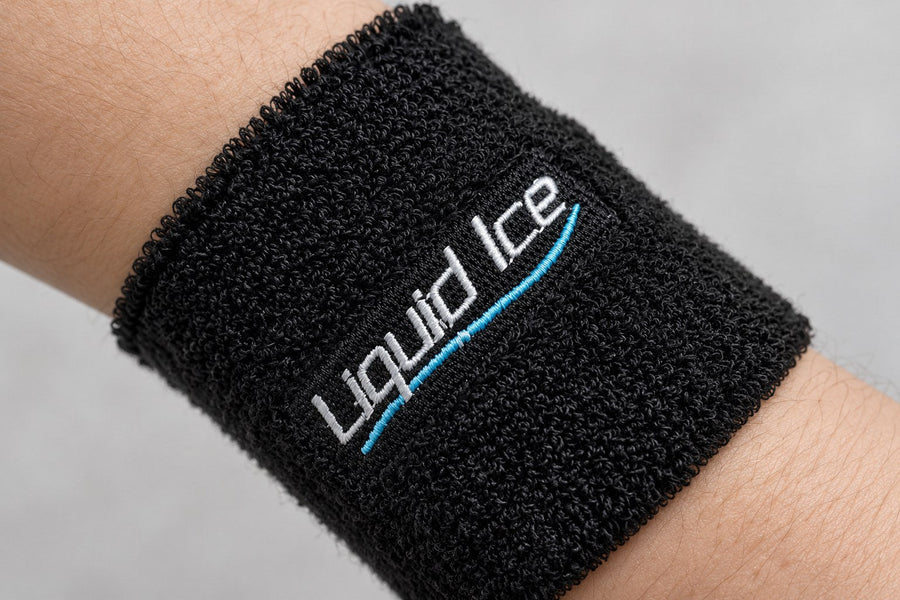
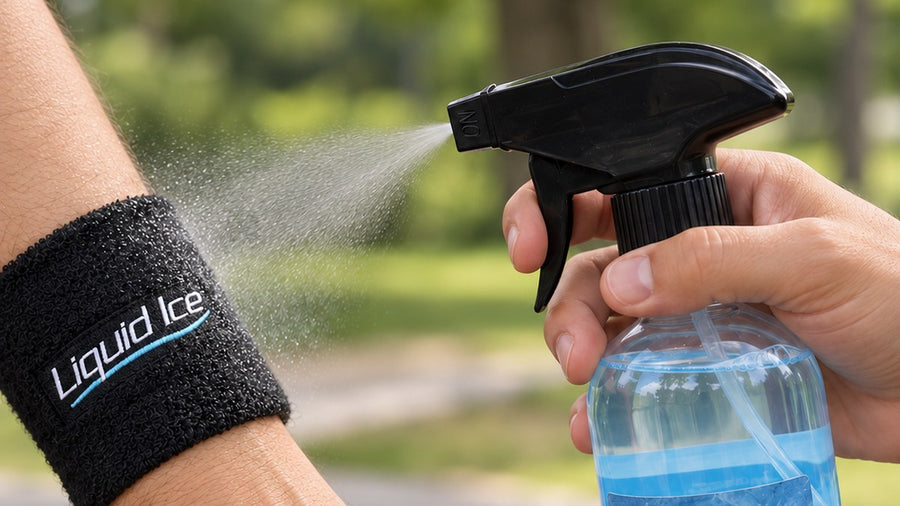
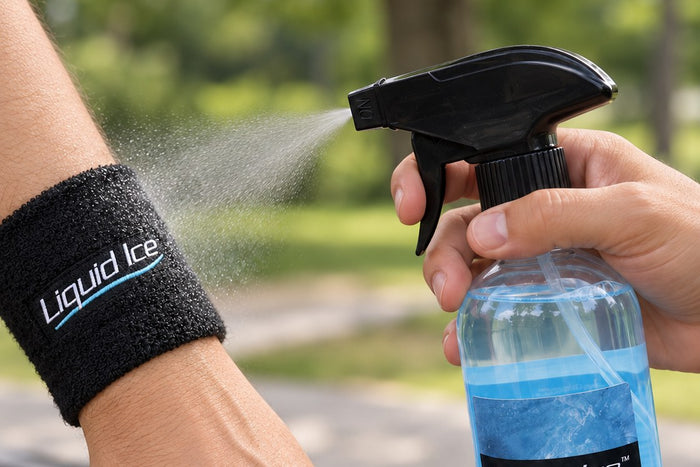
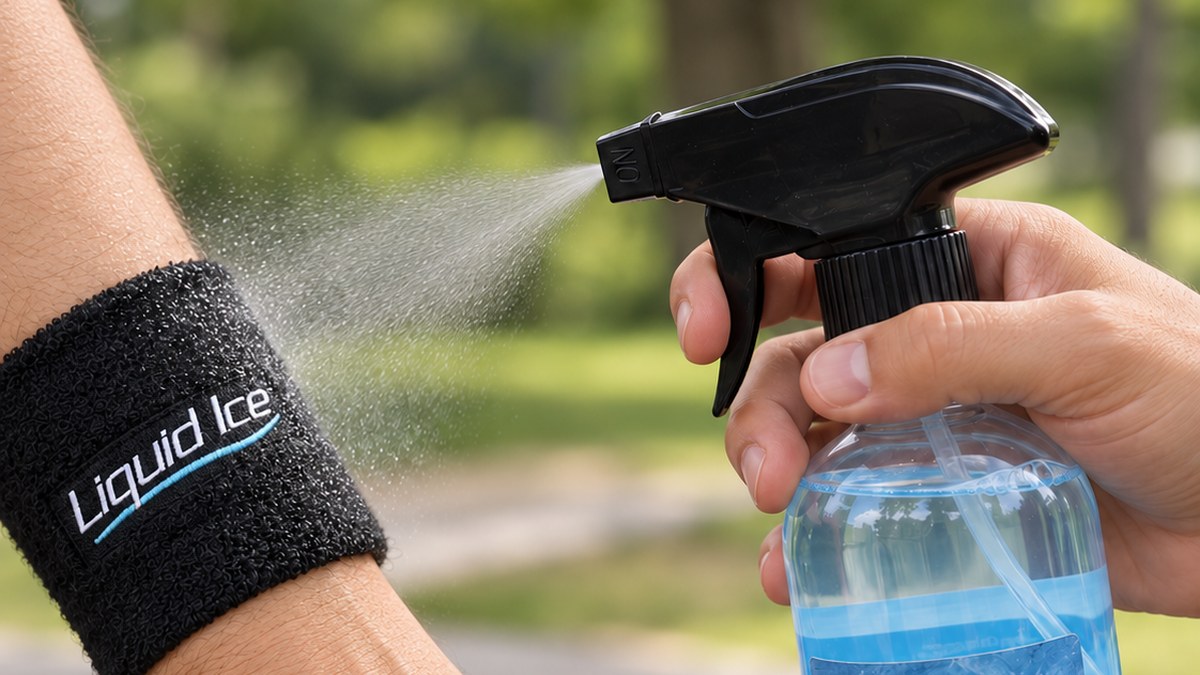
Liquid Ice is a liquid made of water, alcohol, menthol and camphor, with no propellant. The pump sprayer on the 500 ml bottle is just the tool that gets it onto fabric. You spray it on a tight-fitting shirt, a wristband or a bandage until the fabric is visibly damp.
Fabric holds more liquid than a thin film on bare skin and releases it into the air bit by bit. How fast depends on the amount, the heat, humidity and airflow. Alcohol evaporates faster than water, so it feels cold right away; the water takes longer. When it warms up, spray again.
Liquid Ice needs no power and no ice, and it is stored at room temperature.

Measurements exist for the soaked bandage. In 2008 the Dermatest lab in Münster, Germany, tracked the skin temperature of 20 people by infrared over 120 minutes:
Measured on the soaked bandage: 5.8 °C cooler skin, and after two hours it is still cooling.
On a shirt or wristband this has not been measured. How the test was run is in our post on the Dermatest measurement; the bandage itself is the Self Cooling Bandage.
The difference at a glance
| Cold spray, freeze spray | Body mist | Liquid Ice | |
|---|---|---|---|
| What is in it | Liquefied gas, usually butane and propane | Water, often alcohol and menthol | Water, alcohol, menthol, camphor |
| How it cools | Liquefied gas vaporizes instantly | Mist evaporates on the skin | Liquid evaporates bit by bit from fabric |
| Where it goes | A small spot, distance as on the can | On the skin | On a shirt, wristband or bandage |
| How long | Seconds | Until the film has dried | Spray again when it warms up |
| Measured | Varies by product | Varies by product | Soaked bandage, Dermatest 2008 (see above) |
DIY: what plain water on your clothes can do
The simplest evaporative cooling costs nothing. In a heatwave, the NHS advises putting cool water on your skin or clothes. The Global Heat Health Information Network suggests a damp cloth, a spray, or wet clothing. A spray bottle of tap water does the job.
The rule is the same as for every product in this article: it cools while something is evaporating. Once the fabric is dry, the cooling stops.
FAQ
Is Liquid Ice a cooling spray?
No. Liquid Ice is a cooling liquid made of water, alcohol, menthol and camphor, with no propellant. The pump sprayer only gets it onto fabric. It cools your skin as it evaporates from your shirt, wristband or bandage. Measured on the soaked bandage: 5.8 °C cooler skin, and after two hours it is still cooling.
What is the difference between cold spray and cooling spray?
Cold spray is liquefied gas that vaporizes as it leaves the can and sharply chills a small spot for a few seconds. “Cooling spray” has no fixed meaning. Some shops use it for cold spray, others for a body mist of water, alcohol and menthol.
Does cooling spray work?
Cold sprays and cooling mists both work by evaporation, and they cool while something is still evaporating: seconds for a freeze spray, until the film on your skin dries for a mist. How strong the effect is depends on the product and the conditions. Liquid Ice is not one of them: it is a liquid for fabric (see the first question).
What is freeze spray made of?
Usually liquefied gases such as butane and propane, often mixed. Some cold sprays used in medicine contain chloroethane.
How long does Liquid Ice cool for?
Only the soaked bandage has been measured; the number is above. On a shirt or wristband it depends on how much you spray, how hot it is and how much air is moving. When it warms up, spray again.
Do I need to keep Liquid Ice in the fridge?
No. Liquid Ice cools by evaporation, not by stored cold. The bottle is kept at room temperature, no freezer needed.
How to use Liquid Ice for running, cycling and in the gym: Training in the heat. Using a cooling towel? How cooling towels work. More on the mechanism: How Liquid Ice works.
Liquid Ice has been around since 1998. To try it: Liquid Ice 500 ml with pump sprayer.
Sources: OpenStax College Physics 2e: Phase Change and Latent Heat · Wikipedia (DE): Kältespray · Tagesspiegel: how ice spray works · Nobel Prize in Medicine 2021, press release · NHS: Heatwave · GHHIN: Keep Cool · Evaporation of ethanol and water (PMC)