
How do cooling towels work? Evaporation, explained
Soak, wring, snap: what happens inside the towel, why humidity and airflow decide how well it works, and where a towel does not fit.
A cooling towel works by evaporation: water held in the fabric evaporates and takes heat from your skin with it. It cools for as long as water can evaporate from the fabric. Humidity, airflow and sun decide how long that is. Dry, moving air cools more but dries the towel out sooner. Then: re-wet, wring, snap, carry on.
The physics in one paragraph
There is nothing cold inside a cooling towel. It is a fabric that soaks up a lot of water and spreads it over a large surface. Water needs energy to evaporate: about 2,430 kilojoules per kilogram at 37 °C (98.6 °F). Much of that heat comes from the towel and from whatever the towel is lying on. Sweat cools you the same way.
Many cooling towels use one of two materials. PVA feels stiff like a chamois when dry and turns soft when wet. Microfiber mesh stays soft and light either way. Both hold a lot of water and release it across the whole surface.
How cold can a wet towel get?
Only so cold. The limit is the wet-bulb temperature, which the US National Weather Service defines as the lowest temperature that can be reached by evaporating water into the air. It depends on humidity. Two examples, calculated with Stull’s formula (2011):
- 86 °F (30 °C) at 40 % humidity: limit about 69 °F (20 °C)
- 86 °F (30 °C) at 80 % humidity: limit about 81 °F (27 °C)
On your skin a towel usually sits above that limit, because your skin keeps warming it. So in dry heat a wet towel can get much cooler than the air. On a muggy day the gap is small.
How long does a cooling towel stay cool?
As long as water is evaporating from it. There is no fixed number, whatever the packaging says. Three things decide it:
- Humidity. In dry air the water evaporates fast. The towel cools more but dries out sooner. In humid air it stays damp longer and cools less.
- Airflow. Moving air carries the water vapor away and keeps evaporation going. On a bike, the water evaporates faster than in a deckchair.
- Sun. Direct sun heats the towel and the water, and it dries sooner.
When the towel feels merely damp instead of cool, give it a quick snap. If that does not help, wet it again.
How to use a cooling towel
- Soak. Submerge the towel in cool water until it is fully saturated. Tap water is fine.
- Wring. Firmly enough that it is damp but not dripping. A dripping towel is not colder, just wetter, and so is your shirt.
- Snap. Hold two corners and snap it hard through the air a few times. This spreads the water through the fabric and moves air through the fibers.
- Drape it loosely. Around your neck, over your shoulders or under a cap. Air has to reach it. Tucked tight under a collar it cools far less.
- Re-wet. When it warms up, wet it again. A water bottle is enough on the go.
A towel from the fridge feels colder at first. After that, evaporation takes over and the starting water temperature hardly matters.
Towel, neck wrap, neck cooler: the main types
- Evaporative cooling towel (PVA or microfiber mesh): soak, wring, snap. Works best in dry, moving air.
- Evaporative neck wrap or gaiter: the same principle in a tube or a band that stays on while you move.
- Phase-change neck ring: a sealed ring of material that turns solid below its melting point, roughly 14 to 28 °C (57 to 82 °F) depending on the material, and absorbs heat while it melts. Humidity does not matter, but recharging takes time.
- Electric neck cooler: a small fan or a thermoelectric plate, powered by a battery.
For the bigger version of the same choice, see Cooling vest or cooling liquid?
Cooling shirts, wristbands and other cooling clothing compared: What actually cools you in the heat?
Where a towel does not fit, and what does
A towel has to hang somewhere: around your neck or over your shoulders. On the sidelines, in the garden or on a break during a hike, that works well. Running, cycling, or wearing a helmet and workwear, many people would rather not have anything loose there. And you need water to re-wet it.
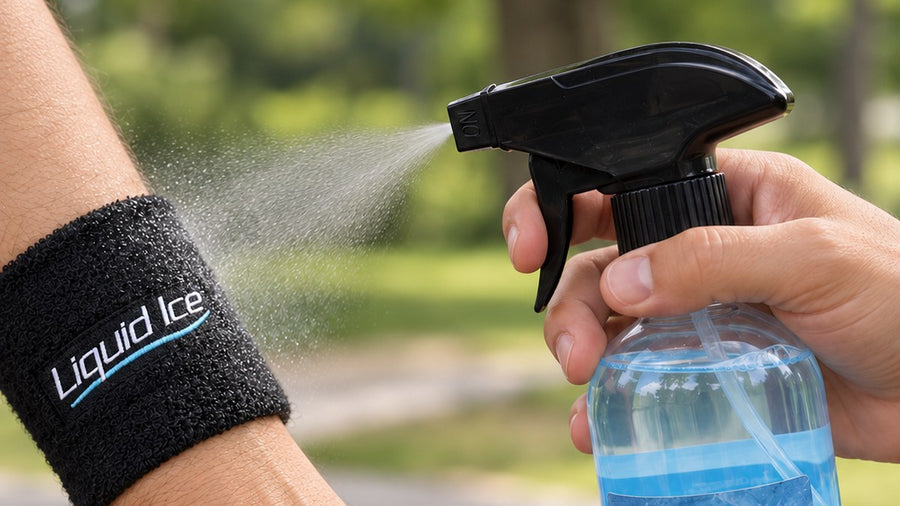
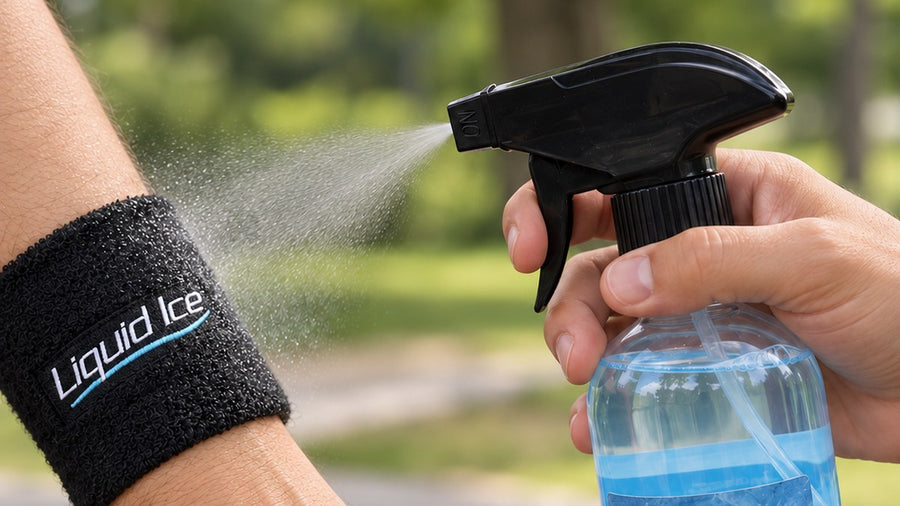
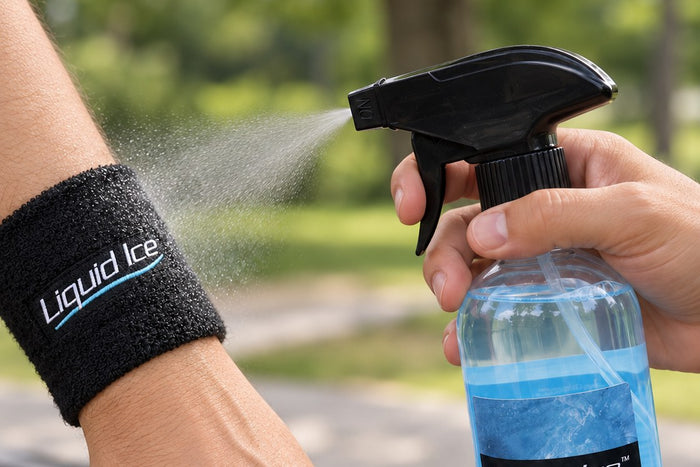
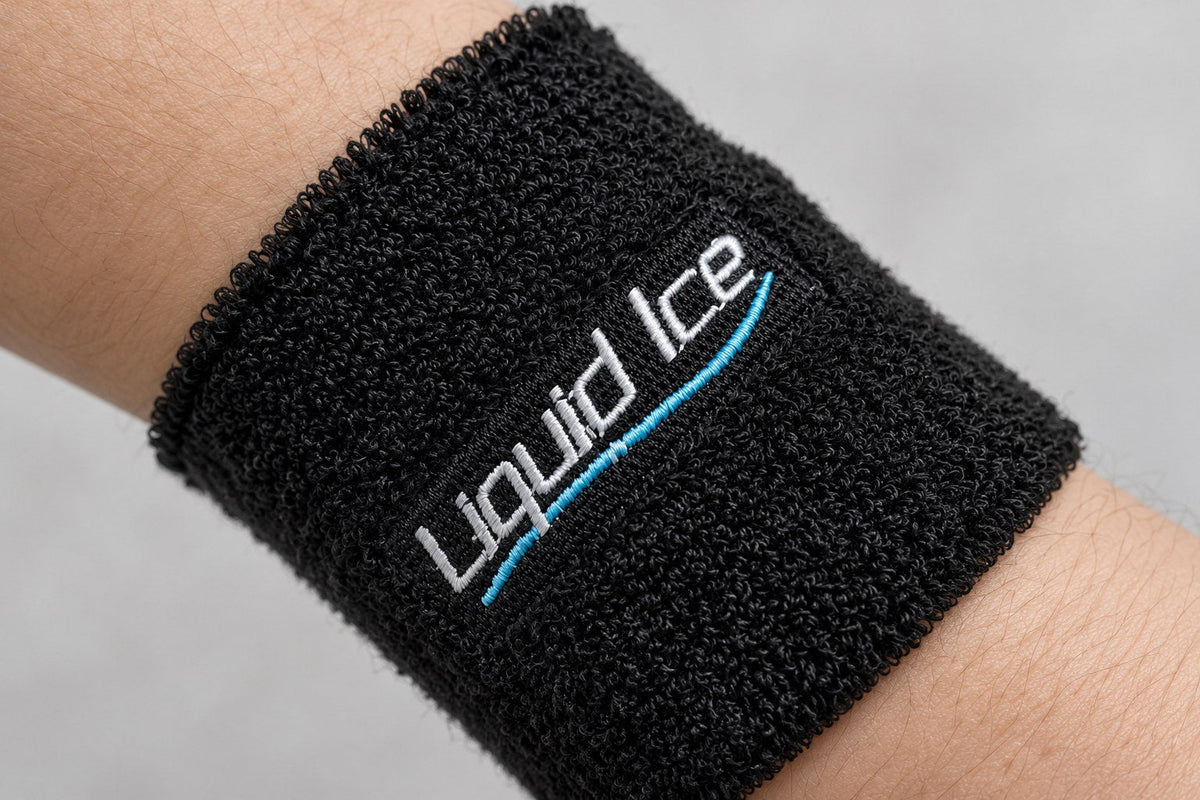
Liquid Ice is a different format of the same idea. The liquid goes onto fabric you are already wearing: a tight-fitting shirt, a wristband or a bandage. The fabric holds it and releases it into the air bit by bit. As with a towel, evaporation does the cooling, and menthol adds to the cold feeling. And as with a towel, evaporation needs air: under clothing that seals in the air, it cools less. The bottle is stored at room temperature.

Measured on the soaked bandage: 5.8 °C cooler skin, and after two hours it is still cooling. That is what the Dermatest lab in Münster, Germany, measured in 2008: 20 people, infrared, 120 minutes. Whether Liquid Ice on a shirt cools more or less than a wet towel, we have not measured.
FAQ
How long do cooling towels stay cold?
As long as water is evaporating from them. In dry, moving air they cool more and dry out sooner; in humid air they stay damp longer and cool less. When it warms up: snap it, re-wet it, wring it.
Do cooling towels work?
Yes. They cool the skin they rest on for as long as water is evaporating from the fabric. They work best in dry air with a breeze, and least on muggy, still days.
Do cooling towels work in humidity?
Yes, but less. The more humid the air, the slower the water evaporates and the closer the wet-bulb temperature gets to the air temperature. At 86 °F (30 °C) and 80 % humidity it is about 81 °F (27 °C).
Do you need to put a cooling towel in the fridge?
No. The cooling comes from evaporation. A chilled towel only feels colder at the start.
How do neck coolers work?
Evaporative neck wraps work like a towel: water evaporates and takes heat with it. Phase-change rings absorb heat while the material inside melts. Electric ones use a fan or a thermoelectric plate and a battery.
How do you wash a cooling towel?
Rinse it in clean water after use so sweat and sunscreen do not stay in the fibers, then hang it to dry. Whether it can go in the machine, and at what temperature, is on the label. Skip fabric softener: it coats the fibers and slows down how fast they take up water.
What is the difference between a cooling towel and Liquid Ice?
A cooling towel is fabric plus water. Liquid Ice is the liquid for the fabric you already wear: a shirt, a wristband or a bandage. Both cool by evaporation. There is no measured comparison between the two.
Cold spray, body mist or cooling liquid? The difference, explained. Liquid Ice in training: Training in the heat.
To try it: Liquid Ice 500 ml with pump sprayer, for your shirt, wristband or bandage.
Sources: OpenStax College Physics 2e: Phase Change and Latent Heat · NWS glossary: wet-bulb temperature · Stull (2011): Wet-Bulb Temperature from Relative Humidity and Air Temperature · GHHIN: Keep Cool