
Cooling clothing: what actually cools you in the heat?
Evaporation, stored cold, reflection: how clothing cools, what the label means and what applies at work.
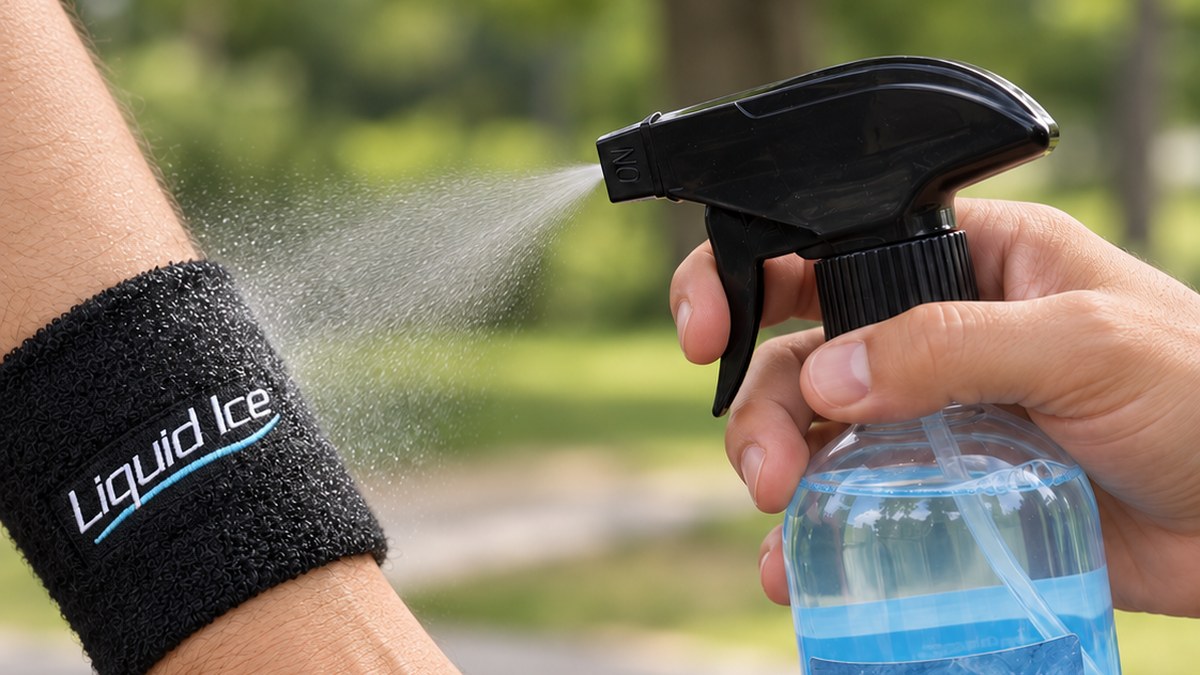
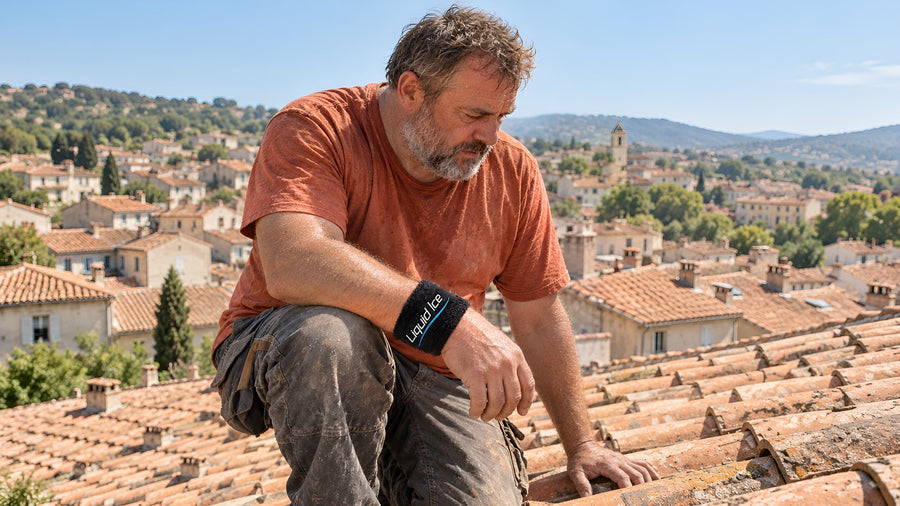
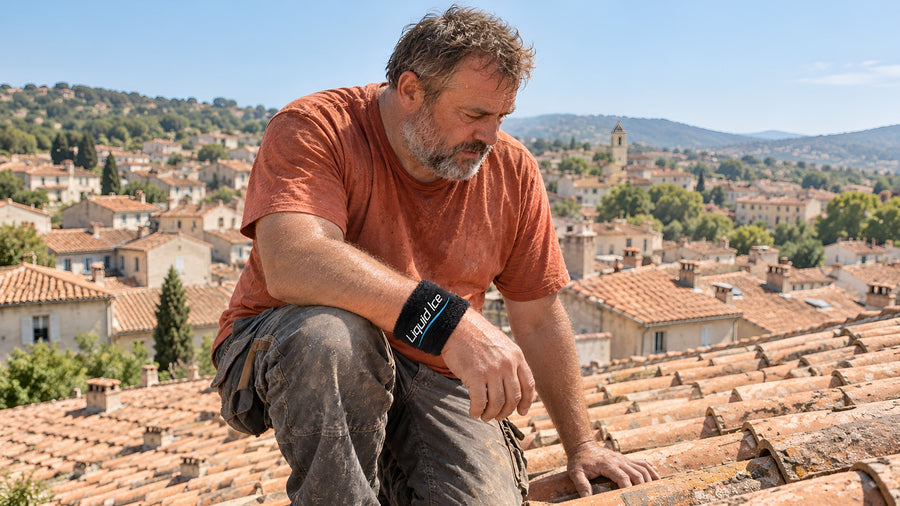
Yes, clothing can cool you, and it does so in one of three ways: water in the fabric evaporates and takes heat away from the skin. Ice and PCM vests release stored cold. Reflective fabrics keep solar radiation out. A sports shirt does not make cold by itself; it only helps sweat evaporate faster.
Is there clothing that cools?
In the heat, the body cools itself mainly through sweat. When water evaporates on the skin, it needs heat to do so, and that heat comes from the skin: at 37 °C, around 2,430 kilojoules for every kilogram of water that evaporates. High humidity slows evaporation down, wind helps it along.
Clothing can slow this process down or support it. That is why a wet shirt feels cool on a hot day. Jan Beringer, an expert in clothing physiology at Hohenstein Laboratories in Germany, advises supporting the body’s own cooling by dampening your clothes, either with your own sweat or with water. The NHS also advises putting cool water on your skin or clothes in hot weather.
Two things decide whether it works:
- The fabric: according to Beringer, sweat evaporates much more effectively on synthetic fibres, because it does not soak into the fibre but only wets the surface. Cotton soaks up moisture, and then hardly anything evaporates.
- The fit: the fabric should sit close to the body so that the cooling effect reaches the skin.
Cooling shirt, cooling vest, cooling towel, cooling wristband: the types
The research literature divides cooling garments into those without power (ice, phase change material, reflective fabrics) and those with power (fans, tubes with chilled liquid, thermoelectric elements). On top of that comes everything that works with water and evaporation. At work and in sport, these are the types you will meet most often:
| Type | How it cools | Needs | Sits on |
|---|---|---|---|
| Sports shirt | moves sweat to the surface, where it evaporates | your own sweat | upper body |
| Cooling shirt you wet | water in the fabric evaporates | water | upper body |
| Evaporative cooling vest | water in the vest evaporates | water and air movement | upper body |
| PCM vest | inserts melt at a fixed temperature and absorb heat as they do | fridge, freezer or iced water | upper body |
| Ice or gel vest | frozen packs give off cold | freezer | upper body |
| Cooling towel, cooling neck towel | water in the towel evaporates | water | neck |
| Cooling cap, dampened neck guard | water evaporates | water | head and neck |
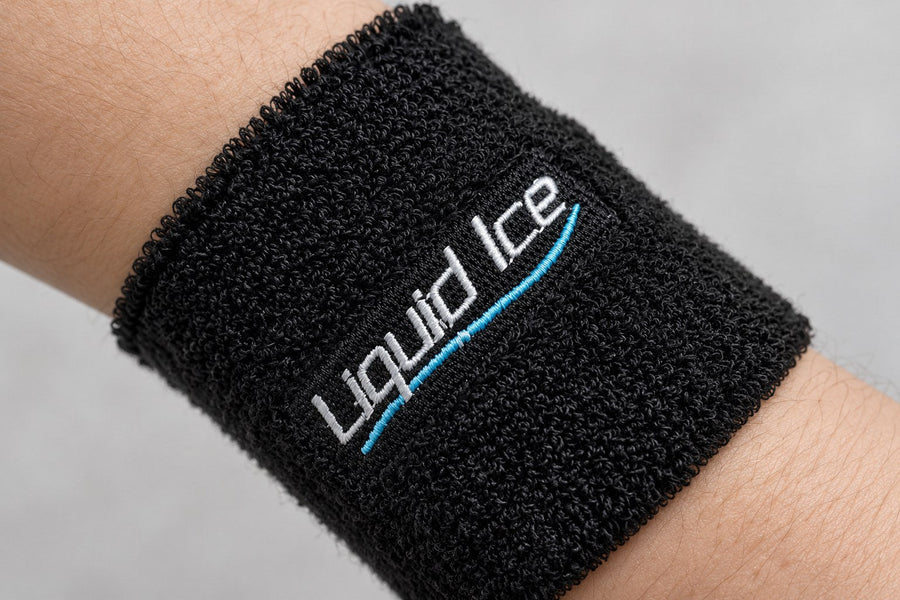
| Shirt, sweatband or bandage with Liquid Ice | Liquid Ice in the fabric evaporates | the bottle | wherever you spray: upper body, collar, wrist, joints |
| Vest or jacket with fans or cooling tubes | air or chilled liquid flows through the garment | battery or cooling unit | upper body |
Vests compared, with their pros and cons: Cooling vest or cooling liquid?
What “cooling” on the label means
On a label, “cooling” stands for very different things. Usually one of four properties is behind it:
- Cool touch: the fabric feels cool when you put it on because it draws heat away from the skin quickly. This is measured as qmax, the peak heat flow at the moment of first contact, for example under the Japanese standard JIS L 1927. The value describes that first moment, not a shift on a building site.
- Moisture wicking (“quick dry”): the fibre moves sweat outwards, where it evaporates faster. The cooling comes from the sweat, not from the fabric.
- Phase change material (PCM) in the yarn: tiny capsules that melt at a set temperature and absorb heat as they do. They buffer temperature peaks; their cooling time is limited.
- Reflective fabrics: they reflect sunlight and give off heat as radiation, so the clothing heats up less in the sun.
UV protection on the label means protection from sunburn, not cooling. For outdoor work in Austria it is still required (§ 5(2) Hitze-V).
Turn any shirt into a cooling shirt: spray on Liquid Ice
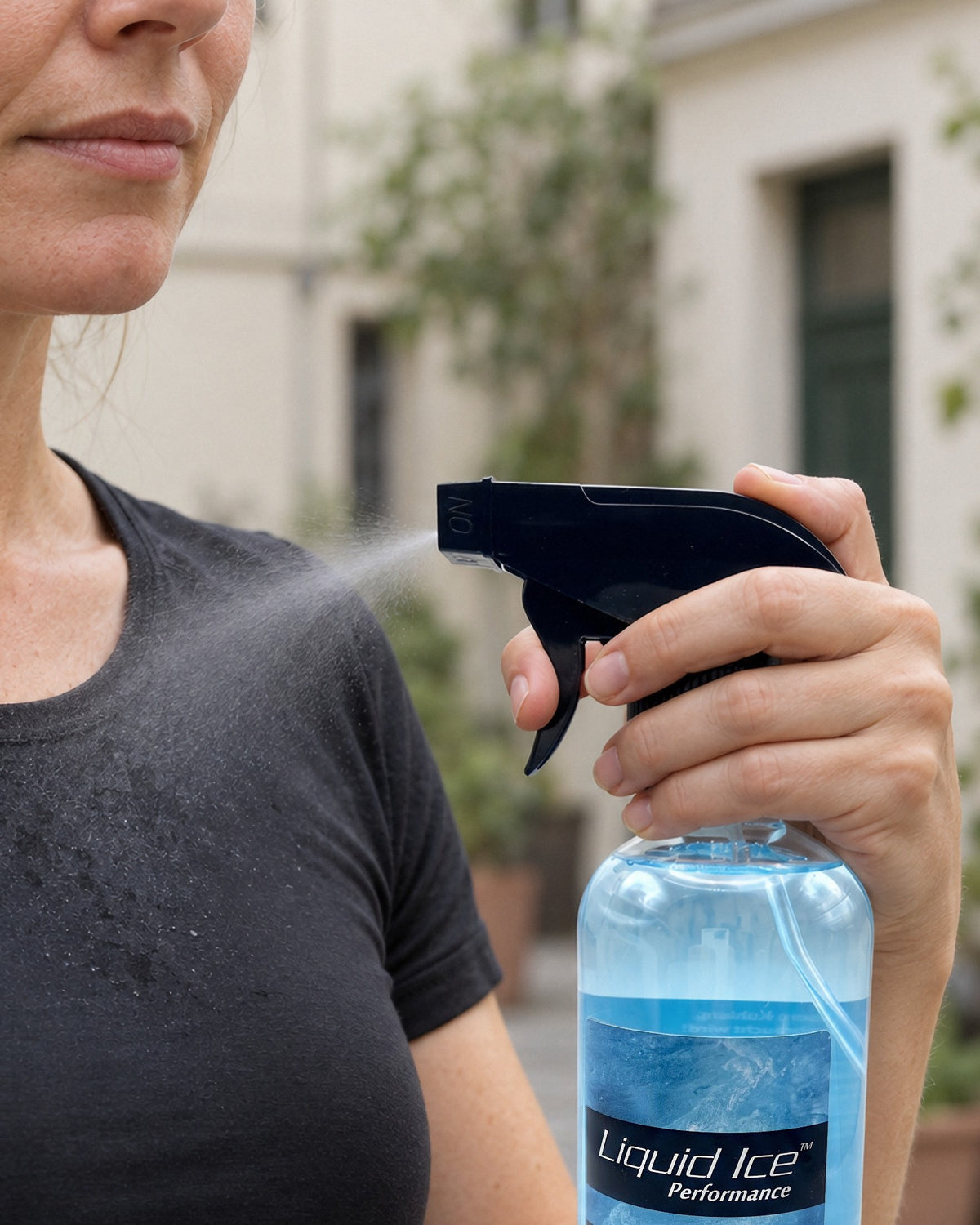
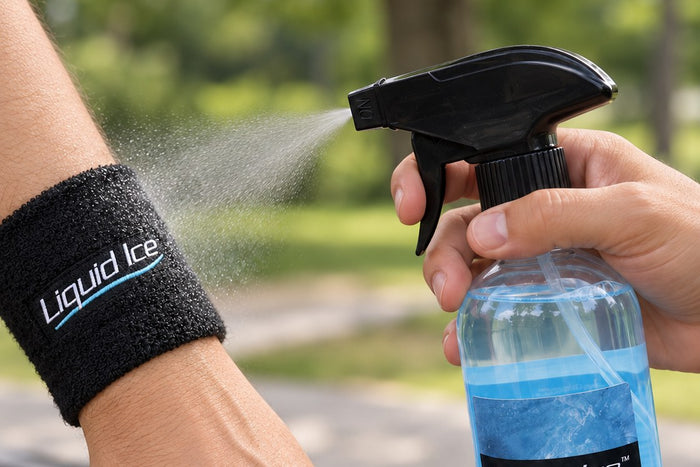
Liquid Ice uses the same principle as a wet shirt, only with a liquid made of water, denatured alcohol, menthol and camphor instead of tap water. You spray it generously with the pump sprayer onto a tight-fitting shirt, a jersey, the collar or a sweatband until the fabric is visibly damp. As the liquid evaporates, it takes heat away from the skin. No power, no ice, no fridge: the bottle is stored at room temperature.
Measured on the soaked bandage: 5.8 °C cooler skin, and after two hours it is still cooling. On a shirt this has not been measured. There, Liquid Ice cools for as long as the fabric is damp; when it feels warm, spray again.
- Shirt and collar: Liquid Ice 500 ml with pump sprayer, plus the Liquid Ice Refill.
- Wrist and forearm: the Self Cooling Band, a tin of Liquid Ice with two sweatbands, or the Cooling Bands to spray.
- Joints: the Self Cooling Bandage to soak in the tin, or the pre-soaked Active Ice Bandage in its pouch.
Use it safely: do not spray Liquid Ice over large areas of bare skin and keep it away from the eyes. It contains alcohol, so do not use it near open flames or during welding, flame or asphalt work. Under dense protective clothing or foil nothing evaporates, so it does not cool there.
Cooling clothing at work
In Austria, the Heat Protection Ordinance explicitly lists “cooling clothing” as a personal measure for outdoor work (§ 4(1) Hitze-V). The labour inspectorate gives cooling vests, cooling caps and cooling neck towels as examples, and its checklist asks: “Can cooling clothing be used?”. The ordinance does not create a general duty to provide work clothing, but the clothing must meet the protection goal. UV-protective clothing, on the other hand, must be provided by the employer: at least a T-shirt to the middle of the upper arm and trousers to the knee.
In Germany, the Committee for Workplaces (ASTA) recommends preferring breathable clothing that lets water vapour through, so that sweat evaporates well. Required protective clothing stays on, even in the heat; the layers underneath should then be less warm. The recommendation also lists headwear with a dampened neck guard, cooling vests above an assessment temperature of 35 °C and, for the break area, basins of water for cooling the forearms.
The same order applies in both countries: cooling clothing is a personal measure and comes after shade, working hours and breaks, not instead of them. For whole crews, Liquid Ice comes in a 25-litre canister: For practices & teams. How to record all of this for your company is shown in our free heat protection plan template. The legal situation at a glance: Heat protection at work and Heat Protection Ordinance: what applies, what cools.
And in sport?
Same principle: a light, close-fitting technical jersey instead of cotton, and water over the jersey. In its report with the Hohenstein expert, aktiv-online calls tipping your drinks bottle over your jersey not a bad idea at all. Spray Liquid Ice onto your shirt or band before the start; when running or cycling, the airflow helps it evaporate. More in our guide Training in the heat.
Common questions about cooling clothing
Which clothing keeps you coolest in the heat?
There is no single answer. The basis is light, breathable clothing that fits closely enough. For the whole upper body over many hours, vests carry the most water or stored cold. For the neck, arms and wrists, a towel, a band or a sprayed collar does the job.
Is cotton or technical fabric better in the heat?
For evaporation, technical fabric. Cotton soaks up sweat and holds it; on synthetic fibres it evaporates more effectively, says Jan Beringer of Hohenstein Laboratories.
How long does a wet shirt keep you cool?
For as long as it is damp. How quickly it dries depends on heat, humidity, wind and effort. In muggy weather less evaporates, so it cools less.
Is cooling clothing mandatory at work?
In Austria, the Heat Protection Ordinance requires a programme of measures and names cooling clothing as an example of a personal measure. Which measures you set follows from your risk assessment. In Germany there is no explicit duty; the ASTA recommendation lists clothing, neck guards and cooling vests as examples.
Can Liquid Ice be worn under protective clothing?
Under dense protective clothing or foil nothing evaporates, so it does not cool there. It works best on a shirt, collar or band where air can reach it, or during breaks.
Does Liquid Ice need a fridge?
No. Liquid Ice cools by evaporation, not by stored cold. The bottle is stored at room temperature and kept tightly closed.
Cold you can wear
One bottle, sprayed generously onto a tight shirt, a jersey or a sweatband. See Liquid Ice 500 ml
Sources
- Heat of vaporisation of water at 37 °C: 2,430 kJ/kg; high humidity slows evaporation. OpenStax College Physics, “Phase Change and Latent Heat”
- Jan Beringer, Hohenstein Laboratories, in: aktiv-online.de, “Sommerhitze: Wie kühlende Textilien die körpereigene Klimaanlage unterstützen”, 30.06.2025 (German)
- NHS: Heatwave: how to cope in hot weather
- Ren S., Han M., Fang J.: Personal Cooling Garments: A Review. Polymers 2022;14(24):5522
- KATO TECH: What Is qmax? JIS L 1927
- Heat Protection Ordinance (Hitze-V), BGBl. II No. 325/2025; Austrian labour inspectorate: Kommentierte Hitzeschutzverordnung (German)
- ASTA recommendation on heat at outdoor workplaces, 21.08.2025, BAuA (German)
- Skin temperature on the soaked bandage: Dermatest GmbH, Münster, 2008, 20 people, see the protocol