
RICE, PRICE or PEACE & LOVE? The first-aid rules for sprains explained
What RICE, PRICE, POLICE and PEACE & LOVE stand for, what the 2019 rule changed about ice and compression, and a practical plan for the first three days after a sprain.
RICE stands for rest, ice, compression and elevation. PRICE adds protection at the front and is the version the NHS uses. PEACE & LOVE, published in the British Journal of Sports Medicine in 2019, keeps protection, elevation and compression, questions ice, and adds what to do after the first few days.
The RICE method
RICE is the classic first aid for a sprain, strain or bruise. Mayo Clinic describes it like this for a sprain:
- Rest: “Your healthcare professional may say not to put weight on the injured area for 48 to 72 hours.”
- Ice: “Ice the area for 15 to 20 minutes, 4 to 8 times a day, for the first 48 hours or until swelling goes down.” Use a dishcloth or thin towel between the ice and your skin.
- Compression: “Compress the area with an elastic wrap or bandage.”
- Elevation: keep it raised on a pillow or cushion above your heart whenever possible.
How long each ice session should last differs between sources. The rules are compared side by side in How long should you ice an injury?
The PRICE method: the NHS version
The NHS tells you to follow PRICE for the first 2 to 3 days after a sprain or strain:
- Protection: “protect the injury, for example by using a support, or shoes that support your foot or ankle.”
- Rest: “stop any exercise or activities and try not to put any weight on the injury.”
- Ice: “apply an ice pack (or a bag of frozen vegetables wrapped in a tea towel) to the injury for up to 20 minutes every 2 to 3 hours.”
- Compression: “wrap a bandage around the injury to support it during the day.”
- Elevate: “keep it raised on a pillow as much as possible.”
In Germany and Austria the same rule is called PECH: Pause, Eis, Compression, Hochlagern. German health insurer BARMER adds an A for Arztbesuch, a visit to the doctor.
POLICE: optimal loading instead of rest
POLICE swaps rest for “Optimal Loading”: gradually using the injured limb again early on, as pain allows (Sherwood Forest Hospitals NHS). The BJSM editorial sums up the history: the acronyms evolved “from ICE to RICE, then on to PRICE and POLICE”.
PEACE & LOVE, letter by letter
Blaise Dubois and Jean-François Esculier introduced PEACE & LOVE in the British Journal of Sports Medicine in 2019. PEACE covers the first days, LOVE the time after.
PEACE: right after the injury
- P for protect: “Unload or restrict movement for 1–3 days.” Avoid long rest; pain tells you when protection can stop.
- E for elevate: raise the limb higher than the heart. The evidence is weak, but so is the risk.
- A for avoid anti-inflammatory modalities: inflammation is part of tissue repair, so the authors say anti-inflammatory medicines should not be standard care. This is also where they put ice: “We also question the use of cryotherapy. Despite widespread use among clinicians and the population, there is no high-quality evidence on the efficacy of ice for treating soft-tissue injuries.”
- C for compress: “External mechanical pressure using taping or bandages helps limit intra-articular oedema and tissue haemorrhage.” The authors note that studies conflict.
- E for educate: an active approach beats passive ones. Electrotherapy, manual therapy or acupuncture early after injury have “insignificant effects on pain and function compared with an active approach”.
LOVE: after the first days
- L for load: get moving and back to normal activities as soon as symptoms allow, without making the pain worse.
- O for optimism: “Optimistic patient expectations are associated with better outcomes and prognosis.”
- V for vascularisation: start pain-free cardio, such as walking or cycling, a few days after the injury.
- E for exercise: restore mobility, strength and balance, with pain as your guide.
RICE vs PEACE & LOVE: is RICE outdated?
| Rule | Stands for | Ice | Compression |
|---|---|---|---|
| RICE | Rest, Ice, Compression, Elevation | yes | yes |
| PRICE | Protection plus RICE | yes | yes |
| POLICE | Protection, Optimal Loading, Ice, Compression, Elevation | yes | yes |
| PEACE & LOVE | Protect, Elevate, Avoid anti-inflammatories, Compress, Educate; Load, Optimism, Vascularisation, Exercise | questioned | yes |
RICE has not been thrown out, it has been narrowed. Compression and elevation stay. Rest becomes a short phase of protection followed by early movement. Ice is optional rather than central, and the advice on anti-inflammatories is new. Some NHS trusts now teach PEACE & LOVE: Leicestershire Partnership NHS Trust tells patients to “follow PEACE for the first 72 hours” and “use LOVE after the first few days”, and still allows an ice pack wrapped in a towel “for up to 20 minutes every 2 to 3 hours” for pain.
What to do in the first 1 to 3 days
- Stop straight away and protect the injury for 1 to 3 days, without resting it for longer than you need to.
- Ice briefly if it feels good, always with a cloth between ice and skin.
- Wrap an elastic bandage firmly but not too tight. Mayo Clinic: loosen it if the pain increases, the area goes numb or swelling appears below the wrap.
- Raise the injury above your heart.
- Avoid HARM for 72 hours: heat, alcohol, running and massage (Aneurin Bevan University Health Board).
- Anti-inflammatory painkillers: PEACE & LOVE advises against them, while the NHS lists ibuprofen gel as an option. Ask a pharmacist.
- Then switch to LOVE: move, load, cardio and exercises, as far as pain allows.
When to see a doctor
Call 999 or go to A&E if you heard a crack, the injured part has changed shape or points at an odd angle, it is numb or tingling, or the skin looks blue or grey or is cold to touch (NHS). Get help from NHS 111 if you can't put weight on it or walk more than a few steps, if the swelling or bruising is large or getting worse, or if the pain is getting worse. See a doctor too if the head, an eye, the ribs or the abdomen are affected (NDR).
Cooling and compression in one wrap
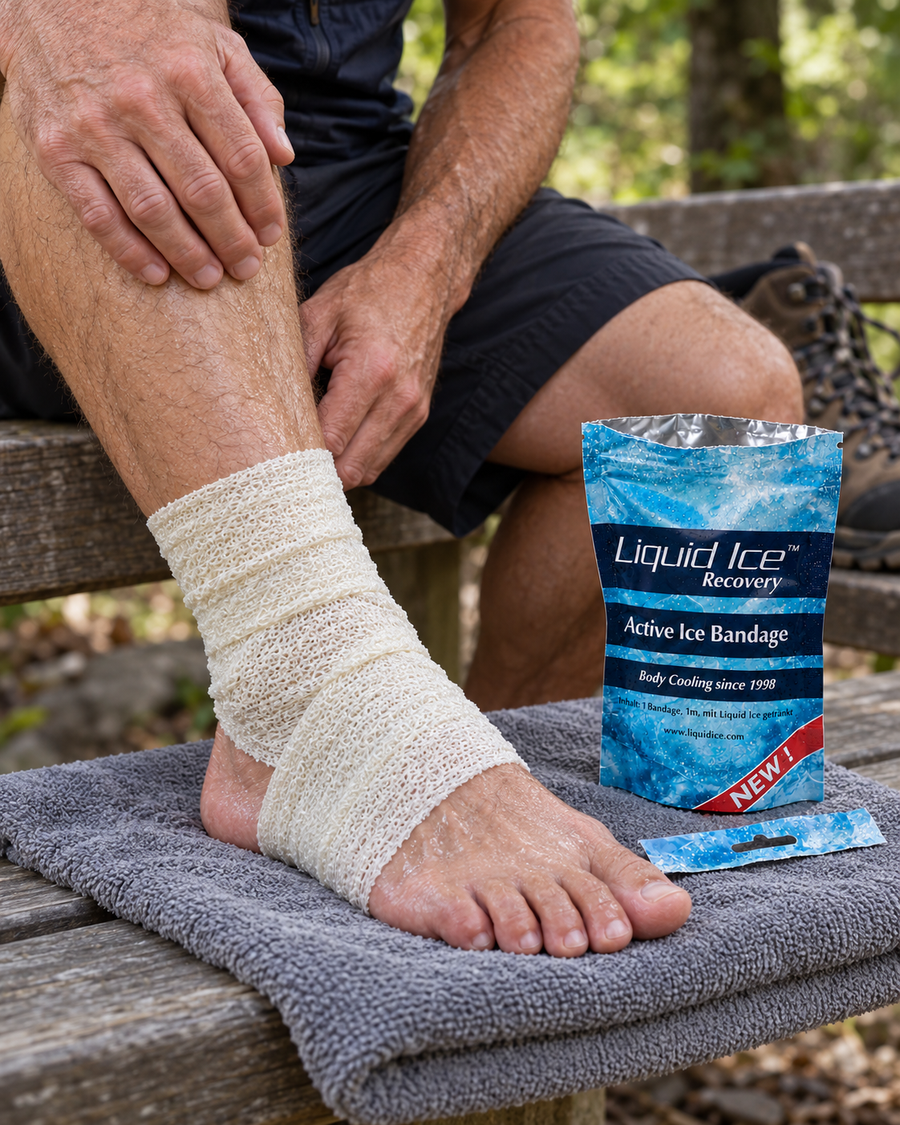
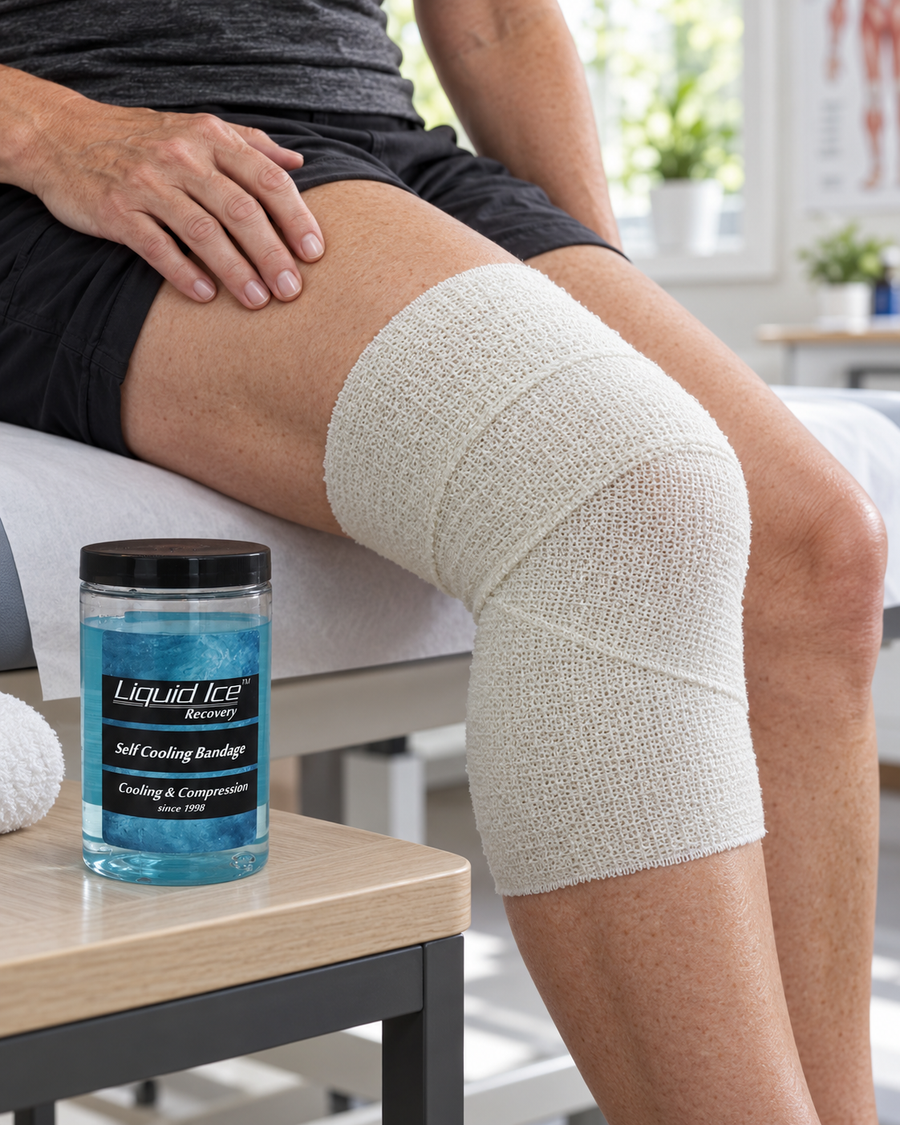
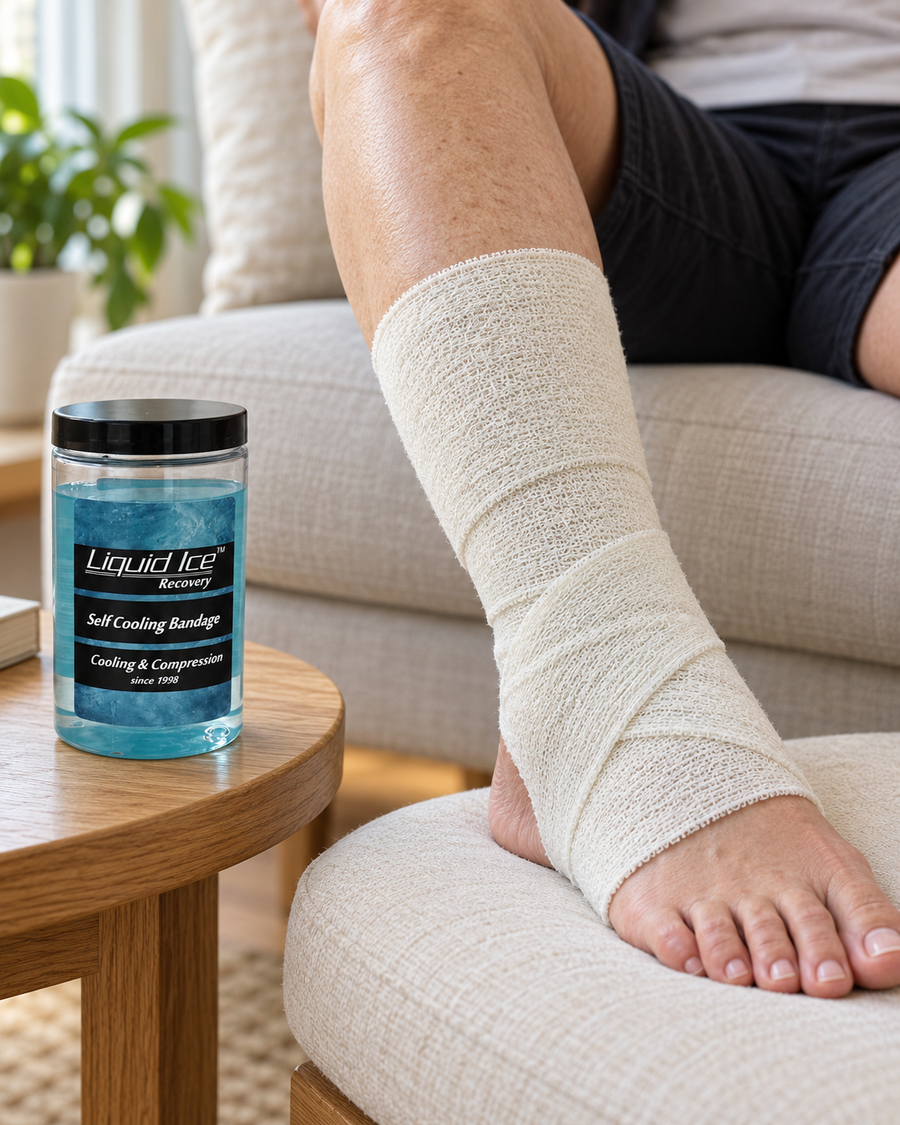
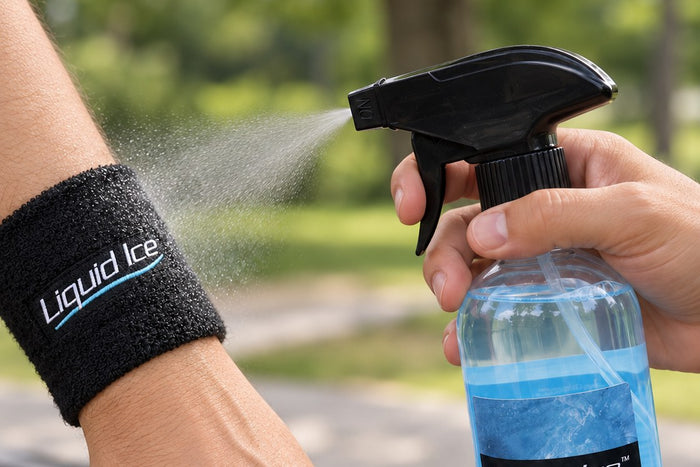
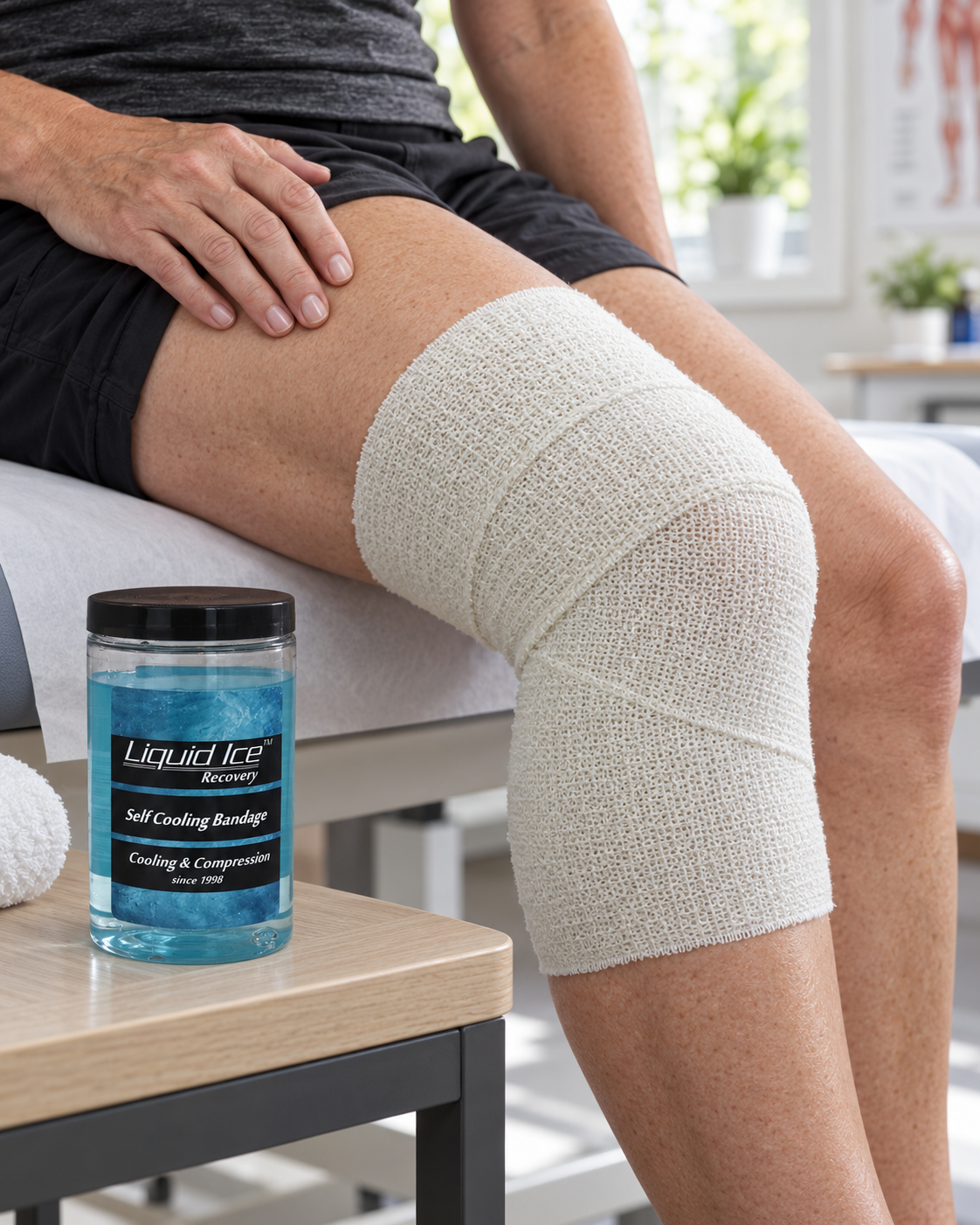
For the cooling and the compression step you usually need two things: something cold and an elastic bandage. The Self Cooling Bandage from Liquid Ice gives you cooling and compression in one bandage. Liquid Ice is a cooling liquid that cools the skin as it evaporates. The can and bandage are stored at room temperature, with no freezer needed. To put it on:
- Soak the bandage in the can, which holds 360 ml of Liquid Ice.
- Wring it out over the can until it is moist, not dripping.
- Start at the bottom and wrap tightly in a spiral upwards, slightly overlapping.
- Tuck the end in. Don't cover or tape it; it needs air.
When it is dry, dip it in the can again, wring it out and wrap it on again. Washing at 30 °C gives it back its full stretch.

Outdoors in sub-zero temperatures and wind, keep the soaked bandage in the can: out there a wet bandage can chill the skin too much. Put it on indoors, at the hut, your accommodation, at home or in the car. Not on open wounds, fresh scars or irritated skin, and keep it away from the eyes.
Self Cooling Bandage · How long to ice an injury
This guide does not replace a medical examination.
Sources
- Soft-tissue injuries simply need PEACE and LOVE, Dubois and Esculier, British Journal of Sports Medicine 2020;54:72, online 2019
- Sprains and strains, NHS, accessed 2 November 2026
- Sprain: First aid, Mayo Clinic, 3 April 2024
- Sprains: Diagnosis and treatment, Mayo Clinic, 29 October 2026
- Soft tissue injury: early management, Sherwood Forest Hospitals NHS Foundation Trust, revised September 2025
- Soft Tissue Injuries, Leicestershire Partnership NHS Trust, September 2026
- Ankle and foot injury advice, Aneurin Bevan University Health Board, February 2025
- Erste Hilfe leisten mit der PECH-Regel, BARMER (Germany), 23 November 2023
- Prellung: schnelle Hilfe durch effektive Behandlung, NDR (Germany), updated 17 July 2024