
Ski knee injury: what to do in the first hour
Twisted a knee on the slopes: the first hour step by step, from the accident site to the hut and the chalet. With the warning signs that mean you should see a doctor.
If you twist your knee skiing, stop straight away, make the spot safe and keep your weight off the leg. If you heard a pop, the knee gives way, you cannot stand on it or it swells quickly, call the ski patrol instead of skiing down. Cool the knee only once you are indoors: in the mountain hut, the chalet or the car.
This guide goes through the first hour step by step and tells you when to see a doctor. The advice comes from the NHS, first-aid organisations and health services; the sources are listed at the end.
How common are knee injuries in skiing?
The knee is injured more often than any other part of the body. Germany's ski accident analysis (ASU Ski), based on accident reports from members of the German Ski Association's DSV aktiv scheme, estimates that 51,000 to 53,000 skiers needed medical treatment in the 2024/25 season. Among adults, 27.1 % of all injuries were to the knee: 37.3 % in women and 20.7 % in men. In Austria, data from the sport and leisure safety department of the Austrian Road Safety Board (KFV) show around 24,000 injured skiers a year.
A typical serious knee injury is a torn anterior cruciate ligament (ACL). Germany's federal health portal names ball sports and skiing as the usual cause and notes that women are affected more often than men.
On the slope: stop, secure the spot, get help
- Stay where you are and keep weight off the knee. The NHS advice for a sprain is to stop any activity and try not to put weight on the injury.
- Secure the accident site. Ram a pair of skis crosswise into the snow uphill of the injured person, about twenty steps away, so other skiers see it in time.
- Keep the injured person warm. Lying in the snow for a long time can chill them badly.
- Get help. 112 reaches the emergency services free of charge from any phone across the EU; in Austria, mountain rescue is also on 140. If you cannot phone, tell the staff at the nearest lift station that the piste rescue service is needed. Say exactly where you are (run, run number, lift), what happened and who is hurt.
Safety rule: do not cool a knee with a wet bandage on the slope. Outdoors in sub-zero temperatures and wind, the soaked bandage stays in the can, because a wet bandage can chill the skin too much there. Put it on once you are indoors: in the hut, the chalet, at home or in the car.
When should you call the ski patrol?
Do not ski down on your own, and call for help, if any of these apply:
- You heard a pop or a crack in the knee when you fell.
- The knee swells up quickly.
- The knee gives way or feels unstable.
- You cannot put weight on the leg.
- The joint looks out of shape.
- Your leg or foot is numb, tingling or has pins and needles, or the skin looks blue or grey or feels cold.
The first three are typical signs of an ACL injury described by MedlinePlus and Germany's federal health portal. NHS guidance lists the others as reasons to go to A&E or call 999.
How long should you ice a knee after skiing?
Once you are inside, raise the leg and cool the knee. The NHS advises an ice pack or a bag of frozen vegetables wrapped in a tea towel for up to 20 minutes every 2 to 3 hours. An NHS trust leaflet on knee injuries suggests crushed ice in a damp towel for 10 to 15 minutes, several times a day. German first-aid organisations go shorter: 10 minutes of cooling, then a 10-minute break.
Ice never goes straight onto bare skin; always wrap it. Why the advice varies so much is explained in our guide How long to ice an injury.
In the chalet: the first two or three days
For the first 2 to 3 days after a sprain or strain, the NHS recommends PRICE: protect the injury, rest it, apply ice, wrap a bandage around it for support during the day and keep it raised. Avoid heat, alcohol and massage for the first couple of days. If none of the warning signs further down apply, an NHS knee leaflet adds: cut back on activity without staying completely still, and gently bend and straighten the knee for 30 seconds every hour while you are awake.
A newer framework, PEACE & LOVE, published in the British Journal of Sports Medicine in 2019, questions the use of ice. Our article RICE vs PEACE & LOVE explains what changed.
Cooling without a freezer: the bandage from the can
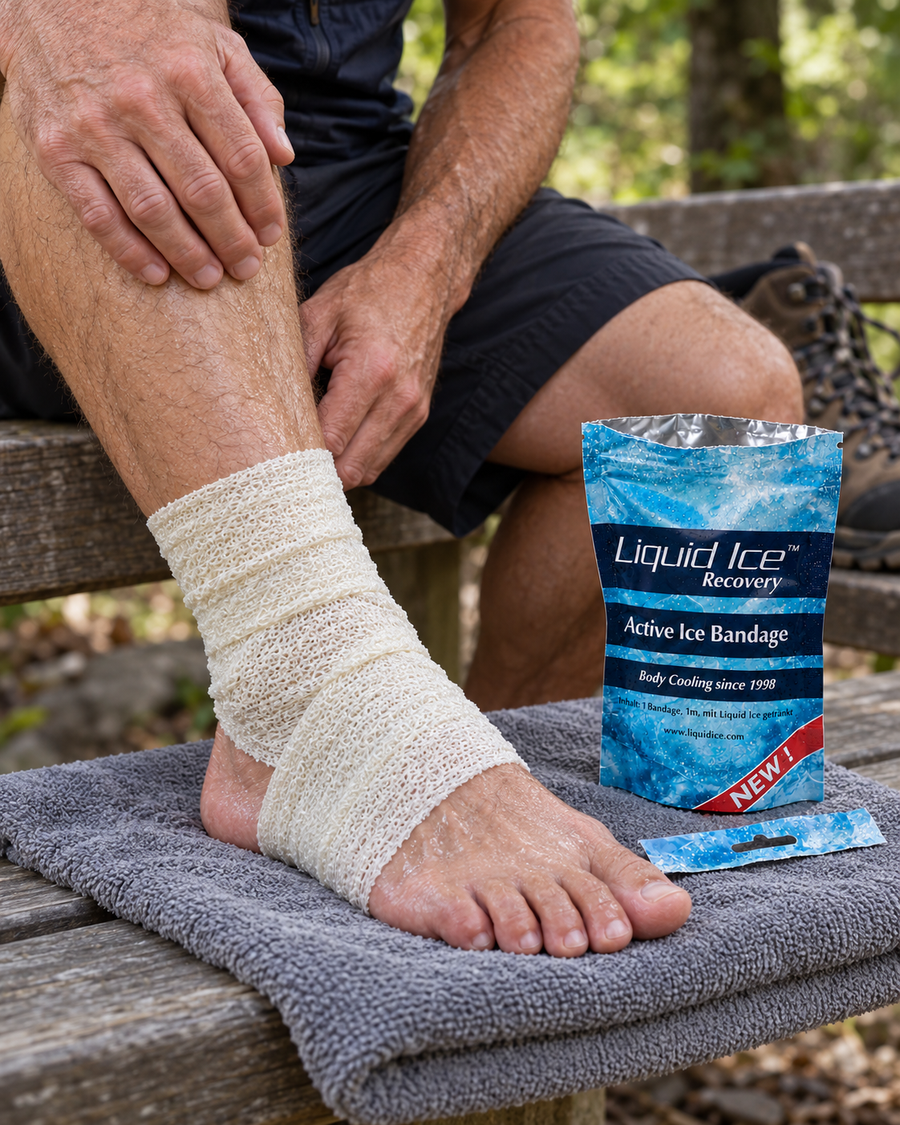
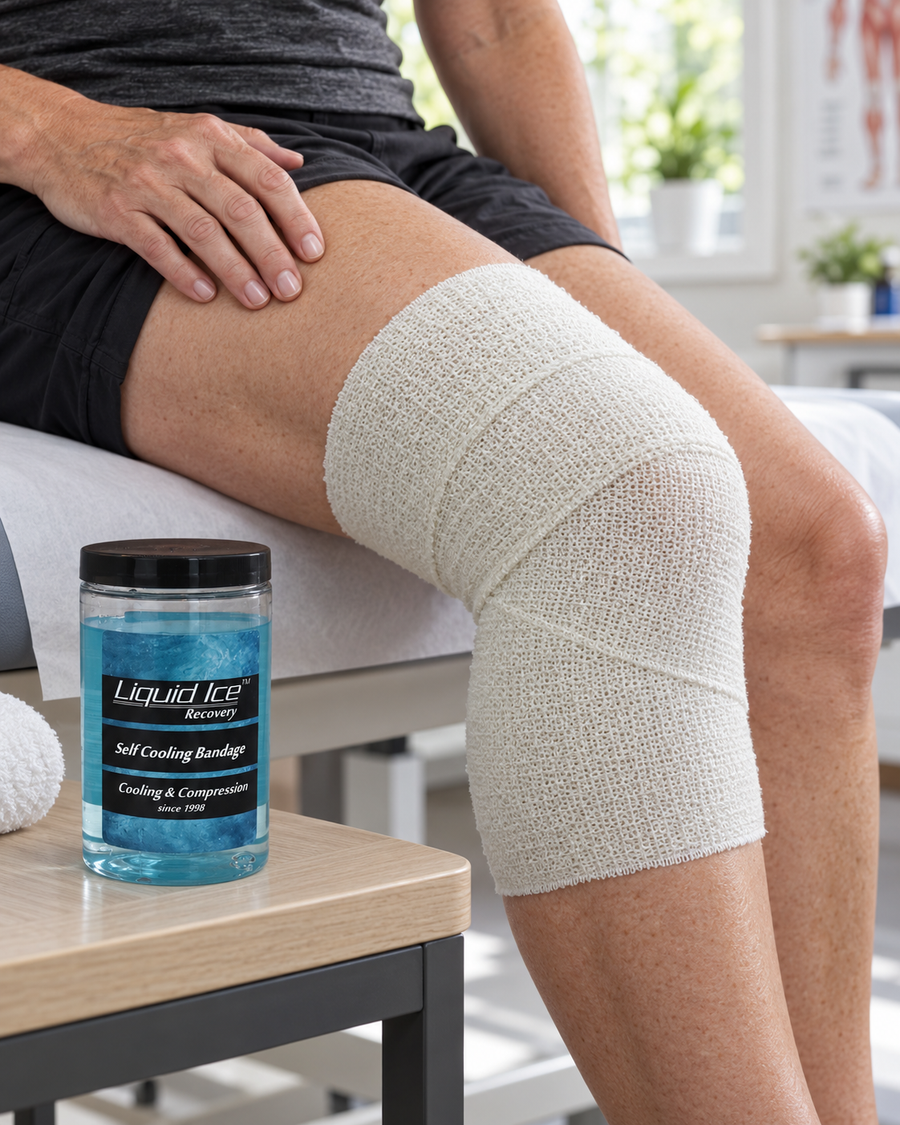
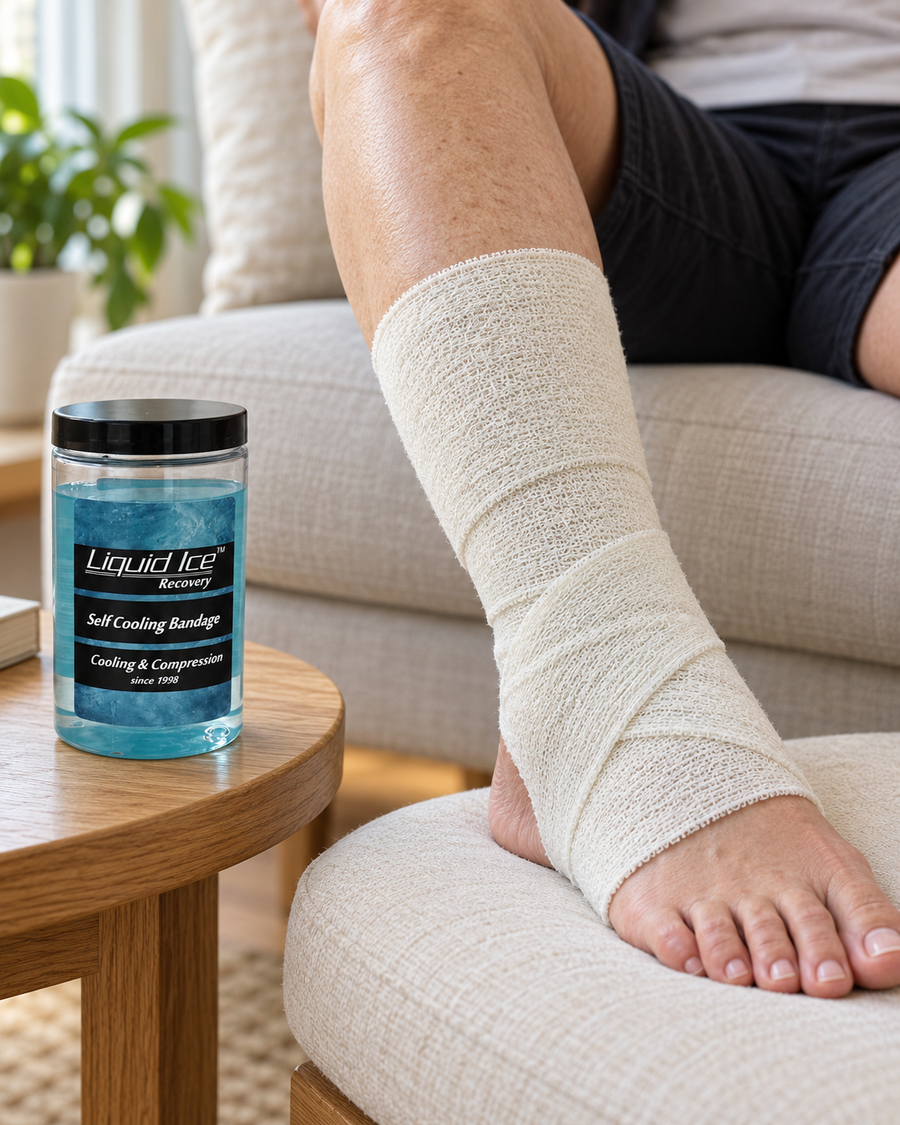
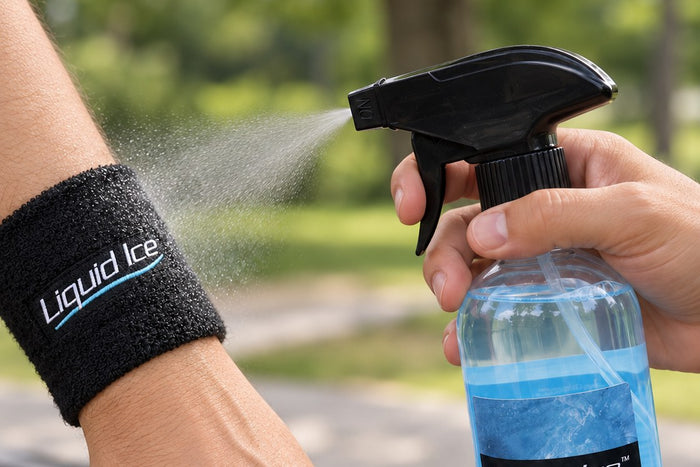
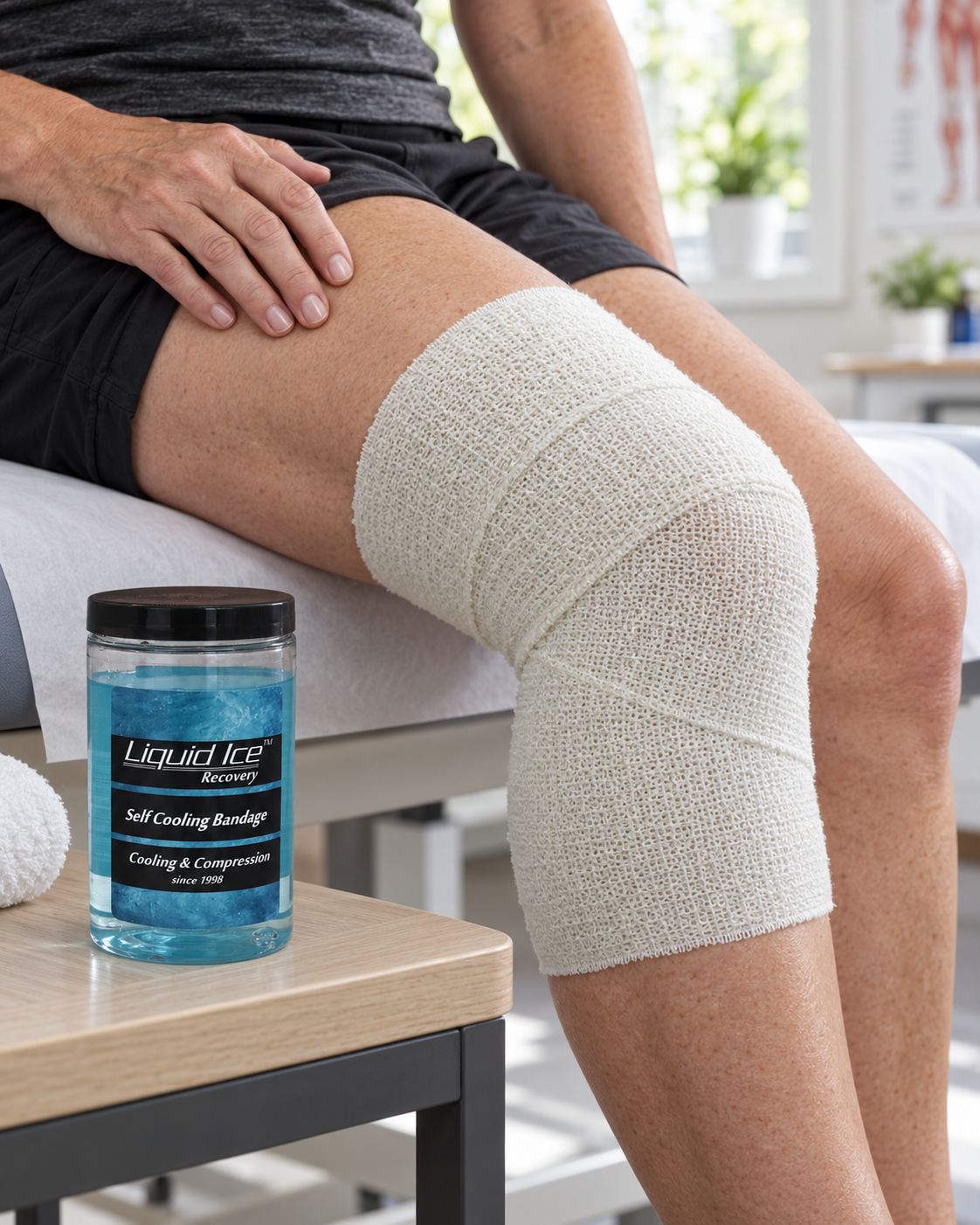
A holiday flat or hotel room without a freezer compartment makes ice hard to come by. The Liquid Ice Self Cooling Bandage needs neither ice nor a freezer. It is a can holding 360 ml of Liquid Ice plus an elastic bandage. Liquid Ice is a cooling liquid made of water, denatured ethanol, menthol and camphor that cools the skin as it evaporates. The can and bandage are stored at room temperature and need no power.

Once you are indoors:
- Soak the bandage in the can.
- Wring it out over the can until it is moist but no longer dripping.
- Start below the knee and wrap firmly in a spiral upwards, each turn slightly overlapping the last.
- Tuck the end in at the top. Do not cover it or tape it; the bandage needs air.
That gives you cooling and compression in one bandage. Measured on the soaked bandage: 5.8 °C cooler skin, and still cooling after two hours. The measurement was taken by Dermatest in Münster in 2008 on 20 people using infrared; read about the measurement. When the bandage is dry, dip it back in the can, wring it out and wrap it again.
Keep the bandage off open wounds, fresh scars and irritated skin, and keep Liquid Ice away from your eyes. Outdoors in sub-zero temperatures and wind it stays in the can. For a step-by-step guide to wrapping a knee, and how to tell if the bandage is too tight, see Knee cooling wrap.
See the Self Cooling Bandage (can and bandage)
Knee swollen after skiing: when to see a doctor
Get someone to drive you. If a bone might be broken, the NHS says not to drive yourself to A&E but to ask someone to drive you or call 999.
An NHS knee leaflet says to go to A&E or speak to your GP if any of these apply:
- Your knee gives way and you fall.
- You cannot fully straighten the knee and it feels blocked.
- You cannot put weight through the leg.
- A lot of swelling appeared within 1 to 2 hours of the injury.
- You have numbness or pins and needles below the knee.
The NHS knee pain page adds a call to 111 if the knee is very painful, badly swollen or has changed shape, or if it locks or gives way. Being able to walk does not rule out a torn ligament: Germany's federal health portal notes that many people walk normally after an ACL tear, but the knee feels unstable, as if the upper and lower leg were shifting slightly.
Shoulder injuries and skier's thumb
Shoulder
The ASU analysis puts the shoulder at 18.6 % of all ski injuries, and at 23.0 % in men, making it the most frequently injured region for male skiers. If the shoulder looks out of shape, or the arm or hand is numb, the same rule applies as for the knee: call 999 or 112. If you can barely move the arm, have it checked by a doctor.
Skier's thumb
Skier's thumb is an injury to the ulnar collateral ligament at the base of the thumb. According to the British Society for Surgery of the Hand (BSSH), falling while holding a ski pole is a common cause. The thumb will be swollen, bruised and painful. Whether the ligament is partly or completely torn decides between a splint and an operation, so a doctor needs to examine it.
Ski-area practices and teams have their own page: For practices and teams.
This guide does not replace a medical examination.
Sources
- Sprains and strains. NHS. nhs.uk
- Knee pain. NHS. nhs.uk
- Traumatic knee injury. East Lancashire Hospitals NHS Trust. elht.nhs.uk
- Anterior cruciate ligament (ACL) injury. MedlinePlus, U.S. National Library of Medicine. medlineplus.gov
- Cruciate ligament rupture. gesund.bund.de, German Federal Ministry of Health, 17.03.2023. gesund.bund.de
- Unfälle und Verletzungen im alpinen Skisport, Zahlen und Trends 2024/2025. ASU Ski (ARAG) with the Stiftung Sicherheit im Skisport, 2025. stiftung.ski
- KFV press release on winter sports injuries. Kuratorium für Verkehrssicherheit (KFV), 21.02.2024. kfv.at
- What to do in an emergency on the ski slope? snow institute, 23.10.2024. snow.institute
- Erste Hilfe beim Skiunfall (first aid after a ski accident). Malteser Hilfsdienst. malteser.de
- Erste-Hilfe-Maßnahmen bei Sportverletzungen (first aid for sports injuries). Malteser Hilfsdienst. malteser.de
- 112: the single European emergency number. Your Europe, European Union. europa.eu
- Selbstschutztipp Skifahren und Snowboarden (ski safety tips). Oberösterreichischer Zivilschutz, 2024. land-oberoesterreich.gv.at
- Soft-tissue injuries simply need PEACE and LOVE. Dubois B, Esculier JF. British Journal of Sports Medicine 2020;54:72 (online 2019). bjsm.bmj.com
- Skier's thumb. British Society for Surgery of the Hand (BSSH). bssh.ac.uk