
Slipped on ice? Bruise or fracture, and what to do at home
After a fall on ice: how to tell a bruise from a fracture, which warning signs mean a doctor, and what to do at home in the first hours.
Most falls on ice end in a bruise or a sprain, but you cannot rule out a broken bone at home. In Austria, two thirds of the people injured slipping on ice or snow had a fracture, according to the safety board KFV. If you heard a crack, a joint looks out of shape, the area is numb or you cannot put weight on it, get medical help. Otherwise, for the first hours: rest it, cool it (never ice straight on the skin), raise it and keep an eye on it.
How common are falls on ice?
Austria's KFV (Kuratorium für Verkehrssicherheit) counts around 7,300 people injured every year in falls on black ice. Two thirds had a fracture, and about a fifth of the injuries seen in hospital were to tendons and muscles. The wrist is hit most often, the KFV says, because people try to break the fall with a hand. In Germany, the orthopaedics and trauma surgery society DGOU reports that the number of seriously injured people over 70 who fall rises sharply in the winter months.
Bruise, sprain or fracture: how can you tell?
Often you can't. For a wrist, the NHS says plainly that "it can be hard to tell if a wrist is broken, dislocated or badly sprained. You'll probably need an X-ray." Swelling and bruising come with all three, so go by the NHS warning signs.
| What you notice | What to do |
|---|---|
| You heard a crack, the body part has changed shape or points at an odd angle, a bone is showing | Call 999 or go to A&E. Do not drive yourself. |
| Numbness, tingling or pins and needles; skin blue or grey or cold to touch | Call 999 or go to A&E |
| You cannot put any weight on it or walk more than a few steps; pain or swelling is getting worse | Get help from NHS 111 today |
| Head, eye, ribs or tummy affected | Get it checked by a doctor |
| Pain, swelling and bruising, but you can still use it | Look after it at home and watch it. If it is not getting better, see a GP. |
Outside the UK, use your local emergency numbers.
Fell on ice: what to do in the first hours
For the first two to three days the NHS recommends PRICE:
- Protection: protect the injury, for example with a support.
- Rest: stop any activity and try not to put weight on it.
- Ice: an ice pack, or a bag of frozen vegetables wrapped in a tea towel, for up to 20 minutes every 2 to 3 hours. Never ice straight on the skin. Sources disagree on timing: How long to ice an injury. What to cool with: four types of cooling bandage compared.
- Compression: a bandage around the injury to support it during the day.
- Elevate: keep it raised on a pillow as much as you can.
Take off rings and bracelets before your hand swells. Avoid heat, alcohol and massage for the first couple of days. How PRICE relates to the newer PEACE & LOVE advice: RICE, PRICE and PEACE & LOVE.
Sprained wrist after a fall on ice
A broken arm or wrist can be painful, swollen, bruised and difficult to move, says the NHS, and may change colour, look bent or feel numb. A sprain can seem harmless at first: with ligament injuries the pain is sometimes mild to begin with, and then lingers (gesund.bund.de, Germany's health ministry portal). While you wait to be seen, use a towel as a sling, hold a wrapped ice pack to it, take off rings and watches, and do not use the arm. If the wrist still hurts after a few days, have it checked.
Bruised or broken hip?
A fall onto the side of the hip is most dangerous for older people. Signs of a broken hip, per the NHS: pain in the hip, upper leg or groin, not being able to stand or put weight on the leg, and a leg at an odd angle or looking shorter. Severe hip pain after a fall or being unable to walk on the leg means 999. Not every break looks like that: Austria's health portal warns that some hip fractures cause little pain and people can still walk. If your hip hurts after a fall, have it checked.
Bruised tailbone from a fall
Slip backwards and you can land on your tailbone (coccyx). The NHS describes pain at the base of the spine that is often worse when sitting, sitting down or standing up. It suggests a coccyx cushion, not sitting for long, and an ice pack wrapped in a towel. See a GP if it has not improved after a few weeks. If you cannot sit at all, a broken tailbone is possible (NDR), so see a doctor.
When to see a doctor about bruised ribs
Bruised ribs hurt most when you breathe in or cough. Most get better by themselves within 2 to 6 weeks (NHS), but Germany's NDR health guide advises seeing a doctor if you suspect a rib injury, because shallow breathing to avoid the pain can lead to pneumonia. Call 999 if breathlessness or chest pain gets worse, you have pain in your tummy or shoulder, or you cough up blood.
Hit your head?
Call 999 if someone was knocked out, cannot stay awake, has a fit, has problems with vision, walking, balance or speech, or has clear fluid coming from the ears or nose. Get help from NHS 111 if they are being sick, feel dizzy or take blood-thinning medicine. An adult should stay with them for the first 24 hours.
Older people should get checked sooner
The DGOU warns that in older people, weaker bone means a fall quickly breaks large, normally stable bones such as the hip. If an older person has fallen on ice, have the hip, wrist and head checked even if it looks minor.
Cooling and wrapping at home without a freezer
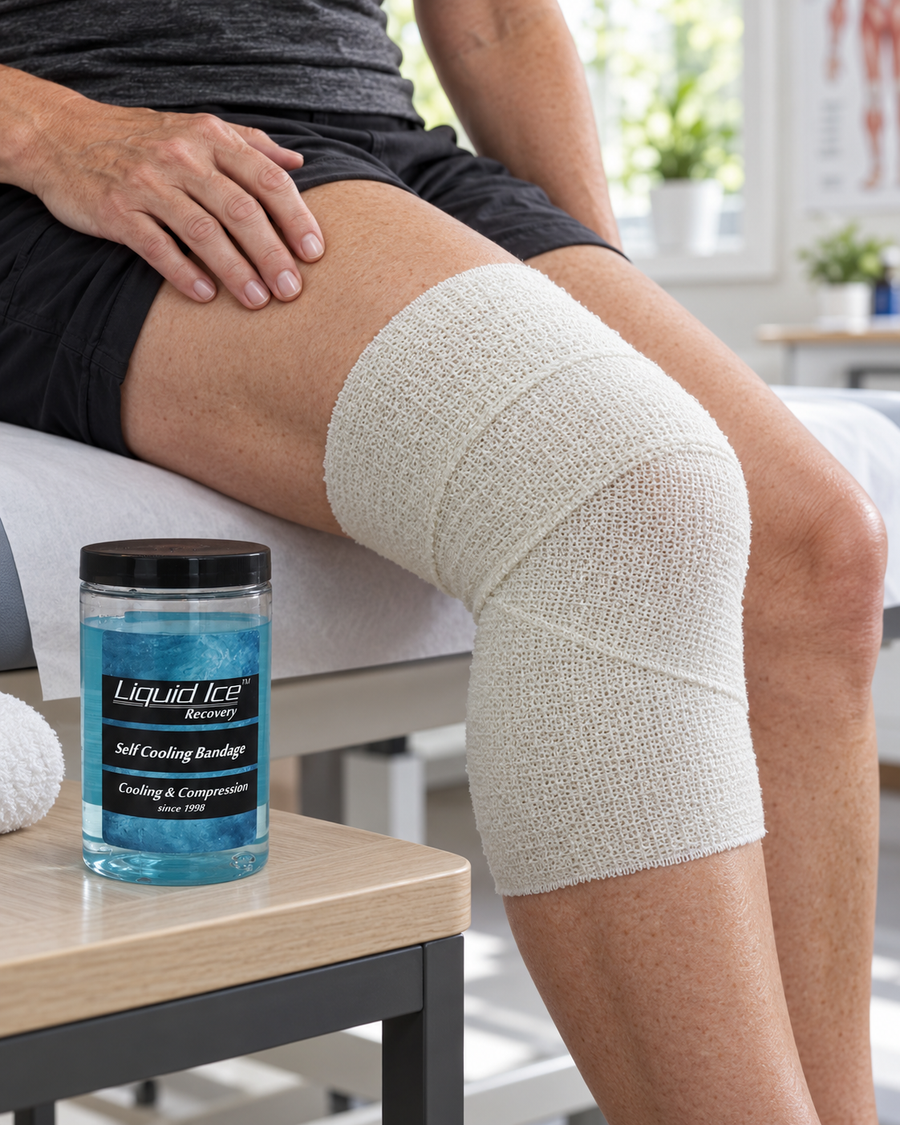
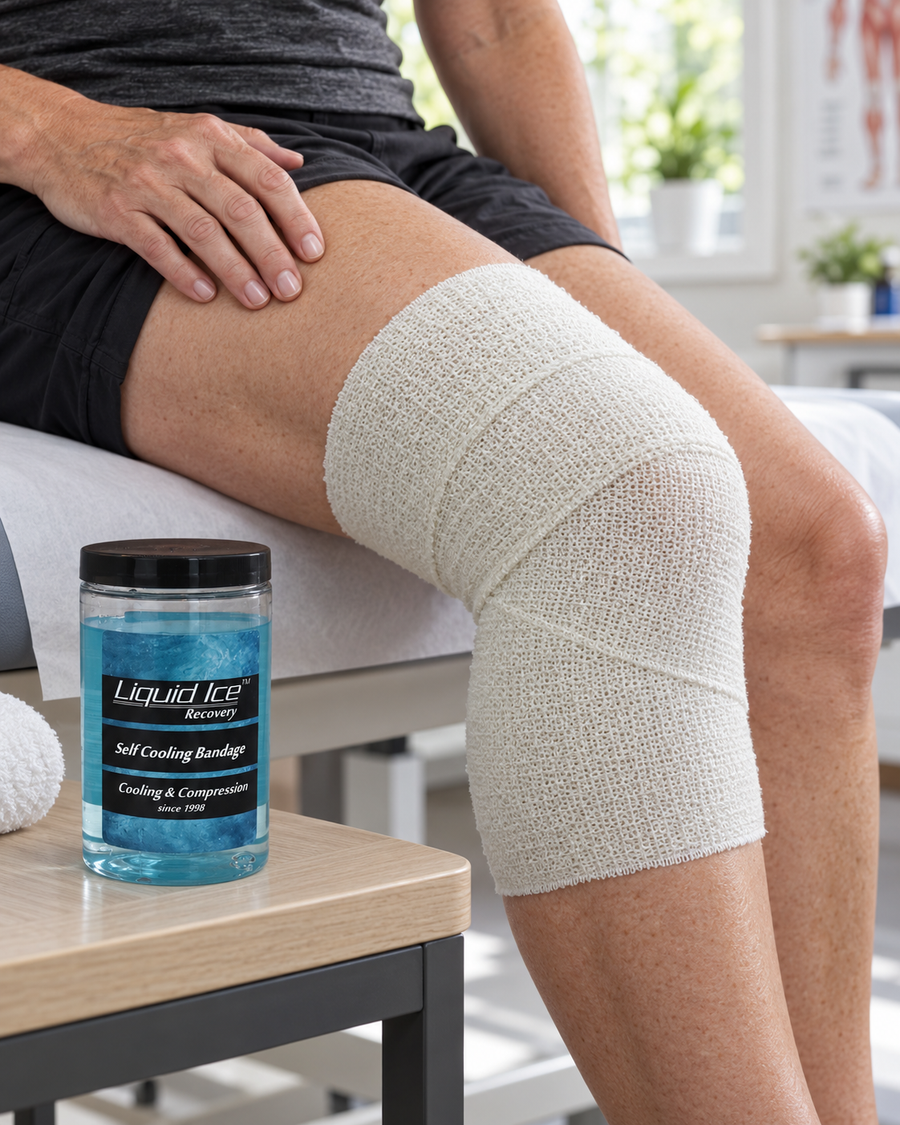
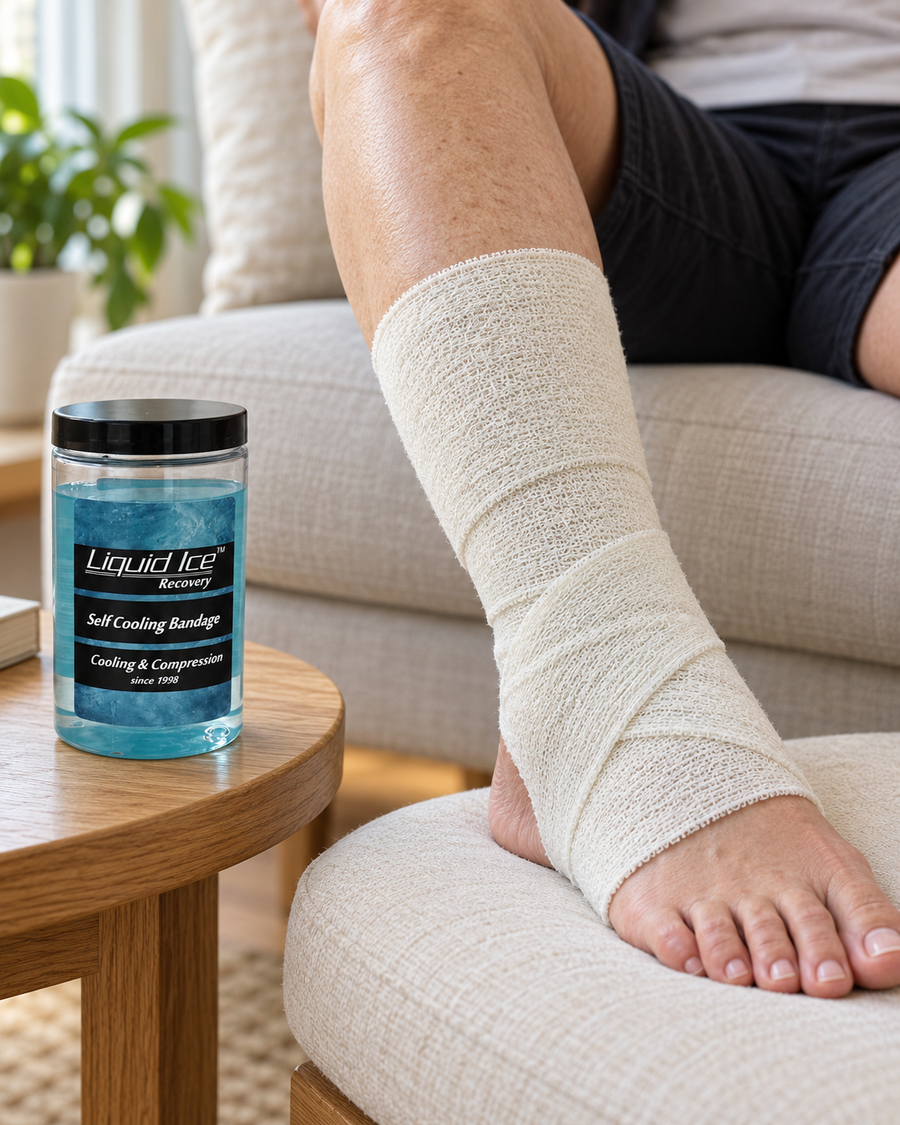
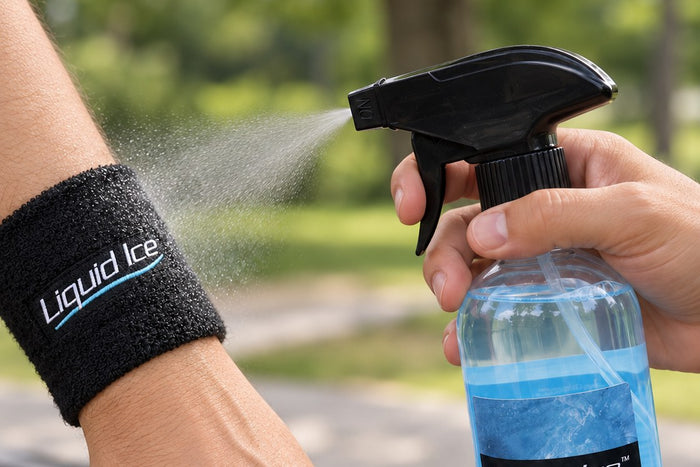
If there are no warning signs and you want to cool a wrist, ankle or knee at home, you do not need a freezer. Liquid Ice is a cooling liquid made of water, denatured ethanol, menthol and camphor that cools the skin as it evaporates. Soaked into an elastic bandage, it gives you cooling and compression in one bandage: the cooling comes from the liquid, the compression from wrapping firmly.
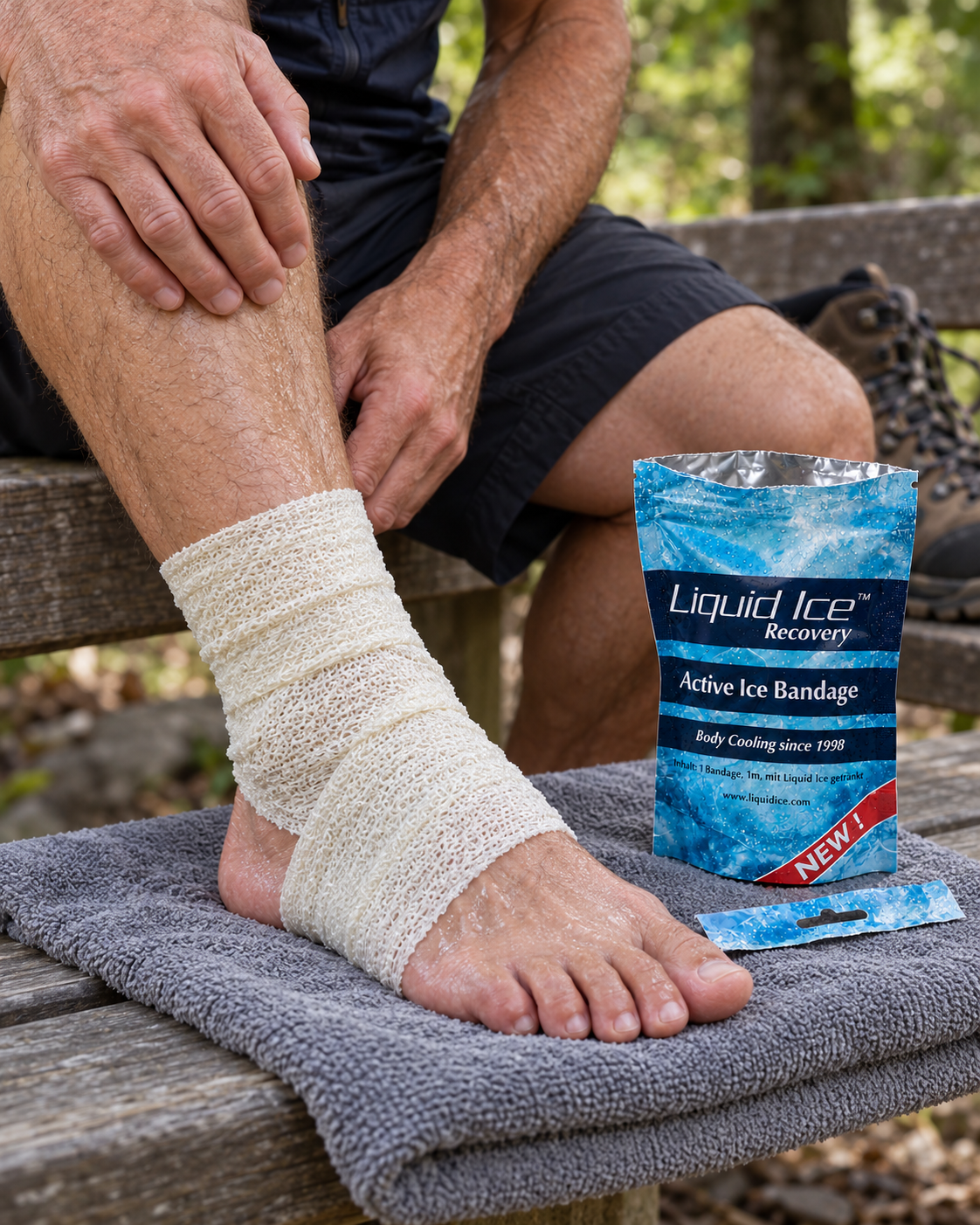
To keep in the house for the winter there is the Active Ice Bandage, one bandage already soaked in a pouch. It is stored at room temperature: no freezer, no power. Tear the pouch open, wring the bandage out over the pouch and wrap it firmly in a spiral from bottom to top, slightly overlapping, then tuck the end in. To re-soak it, pour about 50 ml of Liquid Ice into the pouch. If you cool more often, the Self Cooling Bandage is a can with 360 ml of Liquid Ice and an elastic bandage: dip the dry bandage again, wring it out over the can and rewrap. A wash at 30 °C restores the stretch.
Measured on the soaked bandage: 5.8 °C cooler skin, and still cooling after two hours. Measured by Dermatest in Münster in 2008, on 20 people, by infrared.
- Never cover or tape the bandage. It needs air.
- Not on open wounds or grazes, fresh scars or irritated skin. Keep it away from the eyes.
- Outdoors in sub-zero temperatures and wind, the soaked bandage stays in its pouch or can, because a wet bandage can chill the skin too much there. Put it on indoors: at home, in your accommodation, in the hut or in the car.
Liquid Ice is a cosmetic product. If you have any of the warning signs in the table, see a doctor first.
Preventing falls on ice
- Walk like a penguin: small steps on the whole sole, weight slightly forward (DGOU, KFV).
- Hands out of your pockets, so you can break a fall and the force goes to your hands rather than your head (DGOU, KFV).
- Shoes with a good tread, and slip-on spikes when it is icy (DGOU).
- Hold on: link arms with someone, or use a railing or the wall of a house (DGOU).
- If it can wait, wait two or three hours until the worst of the ice has gone (KFV).
This guide does not replace a medical examination.
Sources
- "Sprains and strains", NHS, reviewed 23 April 2024, nhs.uk
- "Broken arm or wrist", NHS, accessed 2 November 2026, nhs.uk
- "Broken hip", NHS, reviewed 29 July 2026, nhs.uk
- "Tailbone (coccyx) pain", NHS, reviewed 20 November 2025, nhs.uk
- "Broken or bruised ribs", NHS, accessed 2 November 2026, nhs.uk
- "Head injury and concussion", NHS, reviewed 29 May 2025, nhs.uk
- "Vorsicht vor Blitzeis auf Gehwegen – rund 7.300 Verletzte pro Jahr in Österreich", KFV (Austria), 23 January 2024, kfv.at (German)
- "Glatteis: So schützen Sie Kopf und Hüfte bei einem Sturz", DGOU (Germany), 9 January 2025, dgou.de (German)
- "Oberschenkelhalsbruch", Gesundheitsportal (Austria), accessed 2 November 2026, gesundheit.gv.at (German)
- "Handgelenksverletzung", gesund.bund.de (German Federal Ministry of Health), 4 April 2025, gesund.bund.de (German)
- "Prellung: schnelle Hilfe durch effektive Behandlung", NDR Ratgeber, 17 July 2024, ndr.de (German)