
How long should you ice an injury?
How long to ice a sprain, strain or bruise, according to the NHS, Mayo Clinic and others. Plus why ice never goes on bare skin, when to switch to heat and when to see a doctor.
Ice a fresh sprain, strain or bruise for 10 to 20 minutes at a time, then take the ice off. Wrap the ice pack in a cloth and never put it straight on bare skin. How long the break should be depends on the source: the NHS says up to 20 minutes every 2 to 3 hours, Mayo Clinic says 15 to 20 minutes, 4 to 8 times a day, and German first-aid organisations say 10 minutes on, 10 minutes off.
How long to ice a sprain, strain or bruise: the rules compared
| Source | Ice at a time | Break and time frame |
|---|---|---|
| NHS | up to 20 minutes | every 2 to 3 hours, first 2 to 3 days |
| Mayo Clinic | 15 to 20 minutes, never more than 20 | 4 to 8 times a day, first 48 hours |
| Gloucestershire Hospitals NHS | 10 to 15 minutes on a bony area such as the ankle, up to 20 on a large muscle such as the thigh | every 2 hours while awake, first 24 to 48 hours |
| St John Ambulance (bruises) | no more than 20 minutes | not stated |
| Malteser, ADAC, BARMER (Germany) | 10 minutes | 10-minute break, alternating |
| NDR (German public broadcaster) | 15 minutes | 2-hour break, ice on the day of the injury at most |
| British Journal of Sports Medicine | questions ice altogether | no time given |
What the sources say, word for word
- NHS: “apply an ice pack (or a bag of frozen vegetables wrapped in a tea towel) to the injury for up to 20 minutes every 2 to 3 hours.”
- Mayo Clinic: “Ice the area for 15 to 20 minutes, 4 to 8 times a day, for the first 48 hours or until swelling goes down. Don't use ice for more than 20 minutes at a time.”
Why the rules disagree
Older first-aid advice ices often; newer advice ices less. NDR now recommends ice “at most on the day of the accident, briefly” (translated), because cooling may feel good in the first hours but no objective improvement in healing is to be expected. The British Journal of Sports Medicine went further in 2019: “there is no high-quality evidence on the efficacy of ice for treating soft-tissue injuries.” Its alternative, PEACE & LOVE, is explained in our guide to RICE, PRICE and PEACE & LOVE.
In practice: ice briefly if it feels good, mainly on the first day, and let the skin warm up in between.
Can you put ice directly on skin?
No. Mayo Clinic: “Putting ice right on the skin or icing for too long can damage tissue.” Gloucestershire Hospitals NHS: “Never put an ice pack directly onto your skin. Always place a damp cloth on your skin then the ice pack.” It also says to check the skin every 5 minutes and remove the ice if it turns blue, blotchy or very numb. Never put an ice pack over an open wound or graze.
Fridge, not freezer
German health insurer BARMER advises keeping cool packs at home “only in the fridge and not in the freezer” (translated): cooling that is too strong and too long can damage vessels in the skin. NDR agrees. Frozen peas come from the freezer, so keep them wrapped and watch the time.
Ice or heat for a bruise or strain?
Cold first, heat later. Gloucestershire Hospitals NHS: “Do not use heat on a new injury because it may make the problem worse.” Once an injury is over 2 days old, a wheat bag, hot water bottle or bath is fine, but “it should not be hot; gentle warmth will be enough.”
The NHS advises avoiding heat “such as hot baths and heat packs”, alcohol and massage for the first couple of days. NHS Wales’ Aneurin Bevan University Health Board calls this HARM (heat, alcohol, running, massage): avoid it for 72 hours, after which “heat can then be soothing”.
How long does a bad bruise last?
St John Ambulance: “Most bruises settle after a couple of weeks. Seek medical attention if the bruise has not gone after 3 weeks.” For a severe contusion, NDR says full healing can take four to six weeks, depending on where it is.
What to cool with: five options compared
| What | What you need | What to watch |
|---|---|---|
| Ice pack in a cloth | Fridge or freezer | Never on bare skin. BARMER and NDR: fridge-cold, not freezer-cold. |
| Frozen vegetables in a tea towel | Freezer | The NHS and St John Ambulance suggest it. Very cold, so always wrapped. |
| Cold, wet cloth | Cloth and cold water | BARMER suggests a cloth dipped in cold water as a cold compress. Dip it again when it warms up. |
| Cold spray | Spray can | Malteser advises spraying it onto a cloth or T-shirt and laying that on, not straight onto the spot. Follow the label. |
| Soaked cooling bandage | Bandage and cooling liquid, no freezer | Cools as it evaporates and needs air, so don't cover it. Gives compression when wrapped firmly. |
Cooling without a freezer
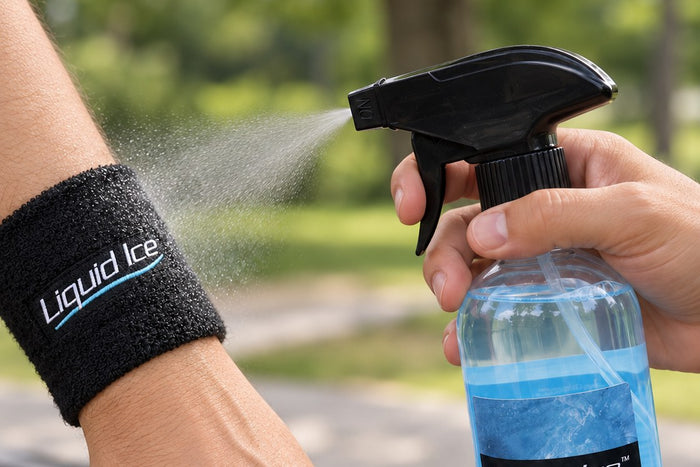
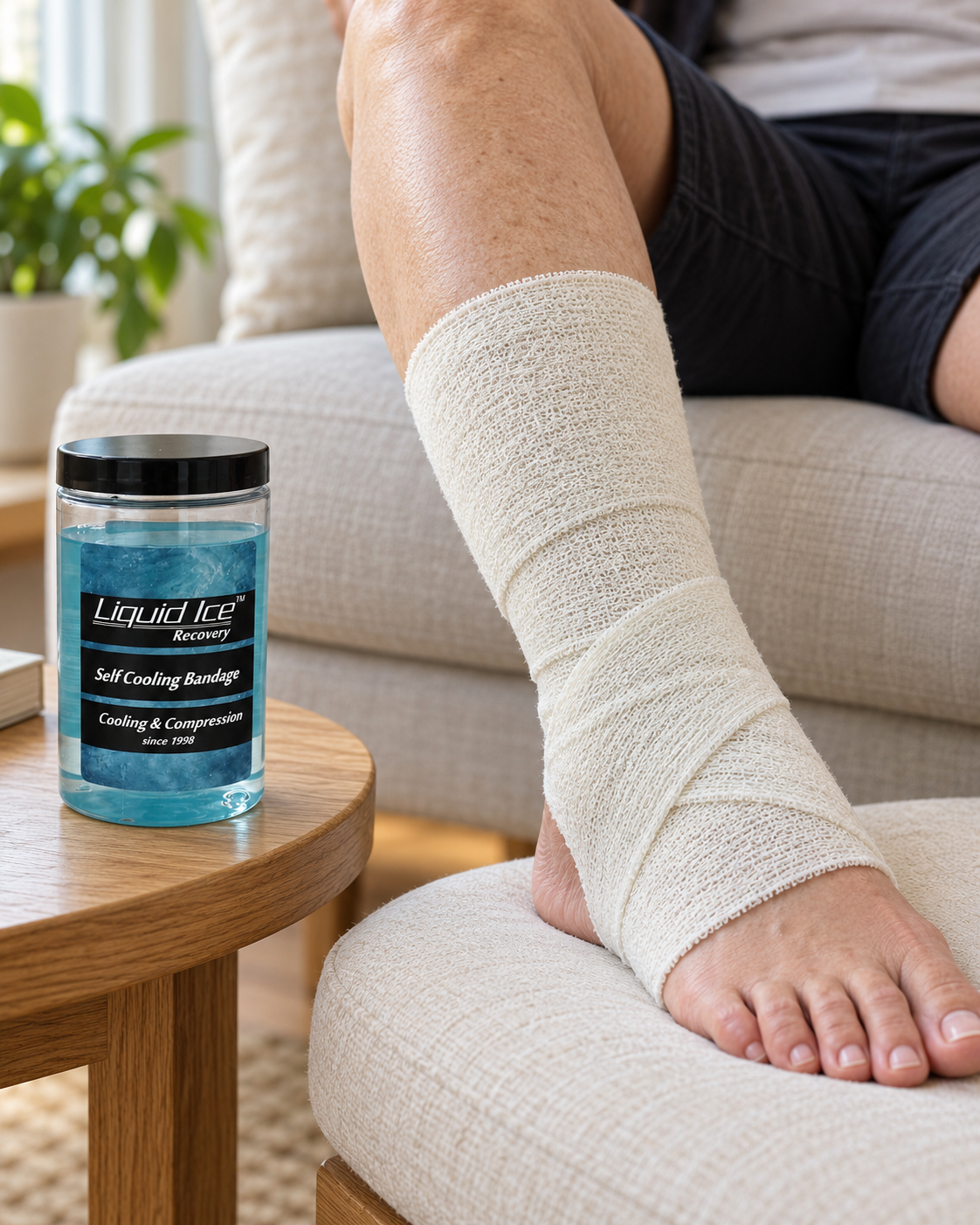
A freezer isn't always to hand: at the ski hut, in the car, at the sports hall. Liquid Ice is a cooling liquid made of water, denatured ethanol, menthol and camphor. It cools the skin as it evaporates. It needs no freezer, no ice, no machine and no power, and it is stored at room temperature. Liquid Ice is a cosmetic product.
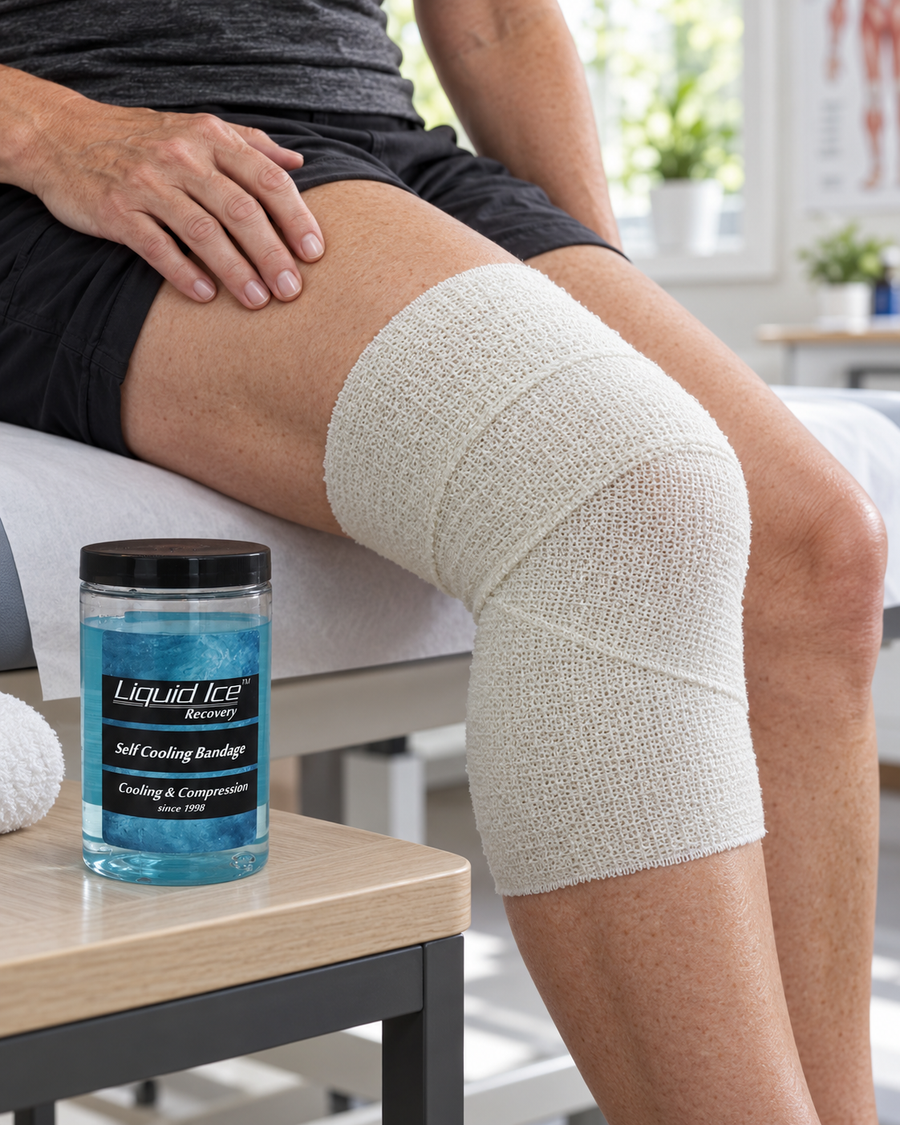
- Self Cooling Bandage: a can with 360 ml of Liquid Ice and an elastic bandage. Soak the bandage in the can and wring it out over the can until it is moist, not dripping. Wrap it tightly in a spiral from bottom to top, slightly overlapping, and tuck the end in. Don't cover or tape it; it needs air. When it is dry, dip it again, wring it out and wrap it on again.
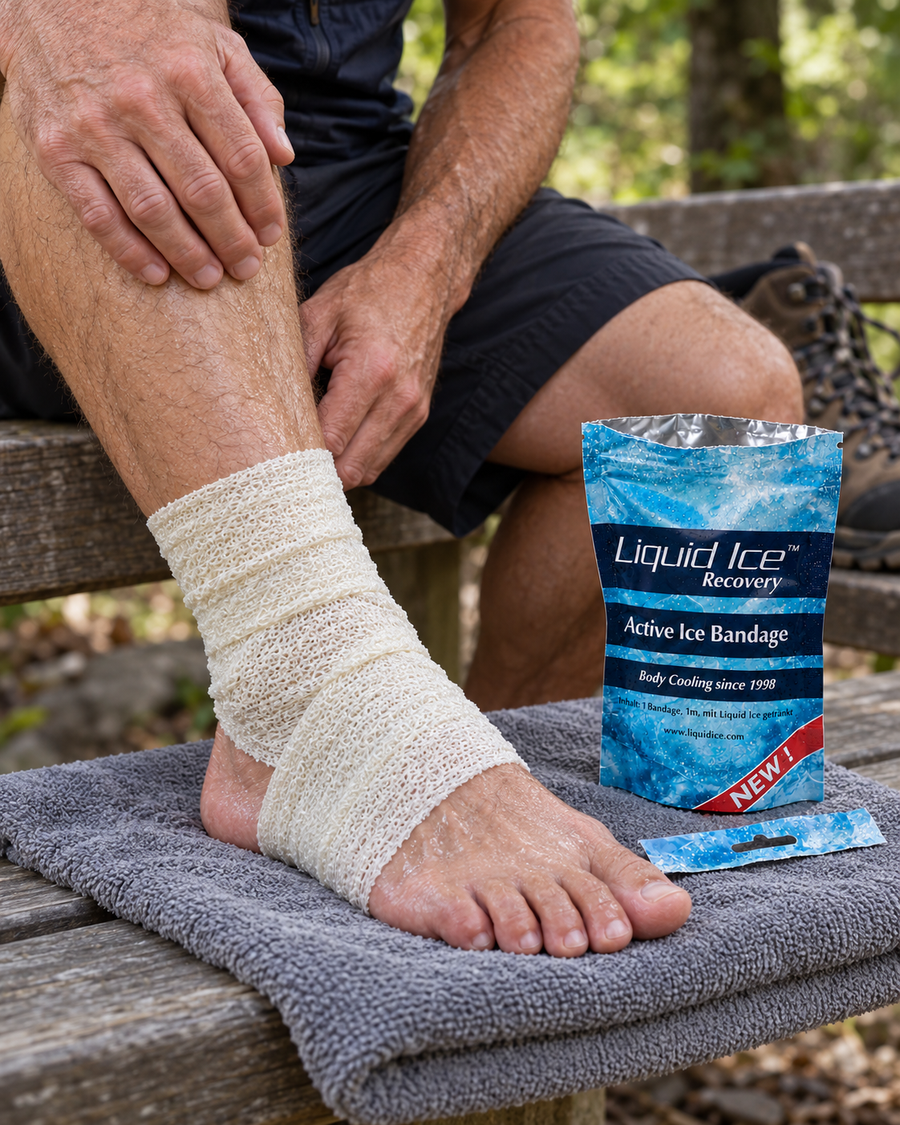
- Active Ice Bandage: one bandage, already soaked, in a pouch. Tear it open, wring the bandage over the pouch and wrap it tightly. To re-soak, add about 50 ml of Liquid Ice to the pouch.
Both give you cooling and compression in one bandage. Measured on the soaked bandage: 5.8 °C cooler skin, and still cooling after two hours. Measured by Dermatest, Münster, in 2008, on 20 people, by infrared (see the measurement).

Outdoors in sub-zero temperatures and wind, keep the soaked bandage in the can: out there a wet bandage can chill the skin too much. Put it on indoors, at the hut, your accommodation, at home or in the car. Not on open wounds, fresh scars or irritated skin, and keep it away from the eyes.
Self Cooling Bandage · Active Ice Bandage · Cooling bandages: four types compared
When to see a doctor
Call 999 or go to A&E if (NHS):
- you heard a crack when you had your injury,
- the injured body part has changed shape or is pointing at an odd angle,
- it is numb, tingling or has pins and needles,
- the skin around the injury looks blue or grey, or is cold to touch.
Don't drive yourself. Get help from NHS 111 if:
- it is very painful, or the pain is getting worse,
- there is a lot of swelling or bruising, or it is getting worse,
- you cannot put any weight on it or walk more than a few steps.
NDR adds: see a doctor if the head, an eye, the ribs or the abdomen are affected. Two common winter injuries have their own guides: ski knee injury: what to do and slipped on ice.
This guide does not replace a medical examination.
Sources
- Sprains and strains, NHS, accessed 2 November 2026
- Sprain: First aid, Mayo Clinic, 3 April 2024
- Ice and heat treatment, Gloucestershire Hospitals NHS Foundation Trust, GHPI0659_02_25 (February 2025)
- Bruises, St John Ambulance, reviewed 28 April 2025
- Ankle and foot injury advice, Aneurin Bevan University Health Board, February 2025
- Erste-Hilfe-Maßnahmen bei Sportverletzungen, Malteser, undated
- Sturzverletzungen: Erste Hilfe bei Bruch, Prellung und Verstauchung, ADAC, updated 22 September 2026
- Erste Hilfe leisten mit der PECH-Regel, BARMER, 23 November 2023
- Distorsion: Symptome, Diagnose und Behandlung der Verstauchung, NDR, updated 20 January 2026
- Prellung: schnelle Hilfe durch effektive Behandlung, NDR, updated 17 July 2024
- Soft-tissue injuries simply need PEACE and LOVE, Dubois and Esculier, British Journal of Sports Medicine 2020;54:72, online 2019