
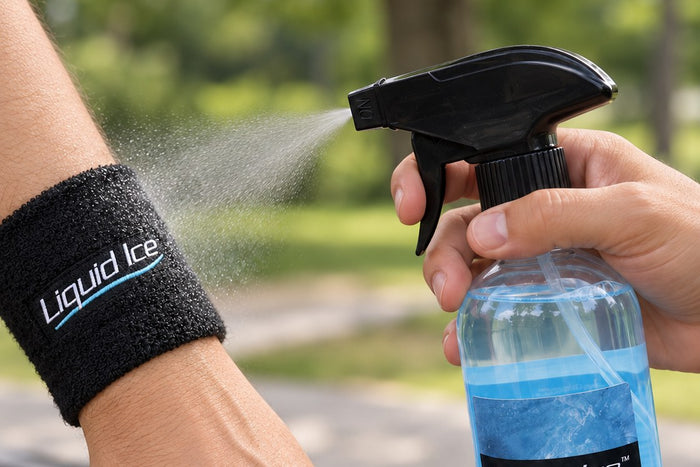

Cooling bandage: four types compared
A cooling bandage should cool where it is needed and stay in place while it does. Practices, clinics and teams have four common ways to do this: the ice or gel pack, the cold spray, the cooling machine with compression, and the bandage soaked in a cooling liquid. Here is what each type needs and how it is used according to its instructions.
Liquid Ice e.U., Klosterneuburg · As of October 2026
The four types at a glance
| Ice or gel pack | Cold spray | Cooling machine with compression | Liquid Ice bandage | |
|---|---|---|---|---|
| Where the cold comes from | Ice or gel from the freezer or fridge | Liquefied gas that cools as it evaporates | Iced water in the machine or a built-in chiller, depending on the model | Cooling liquid in the bandage, which cools as it evaporates |
| Preparation | Pre-cool as the pack says, wrap in a cloth or cover | Shake the can | Fill the machine with water and ice, connect hose and cuff | Soak in the can, wring out over the can |
| Use according to the instructions | At most about 20 minutes at a time, then a break | Spray for a few seconds from at least 15 to 20 cm | About 30 minutes, then a break of at least 30 minutes | Wrap firmly, tuck the end in securely at the top |
| Compression | Only with an extra bandage | None | Yes, through the cuff | Yes, in the same bandage |
| Movement during use | The pack is held or tied on | Yes | Via a hose to the machine, which stands on the floor or a table | Yes, with no machine and no hose |
| Storage | Freezer or fridge | Room temperature | Machine in the room, ice from the freezer | Room temperature |
Ice or gel pack
- Where the cold comes from: Ice or gel from the freezer or fridge
- Preparation: Pre-cool as the pack says, wrap in a cloth or cover
- Use according to the instructions: At most about 20 minutes at a time, then a break
- Compression: Only with an extra bandage
- Movement during use: The pack is held or tied on
- Storage: Freezer or fridge
Cold spray
- Where the cold comes from: Liquefied gas that cools as it evaporates
- Preparation: Shake the can
- Use according to the instructions: Spray for a few seconds from at least 15 to 20 cm
- Compression: None
- Movement during use: Yes
- Storage: Room temperature
Cooling machine with compression
- Where the cold comes from: Iced water in the machine or a built-in chiller, depending on the model
- Preparation: Fill the machine with water and ice, connect hose and cuff
- Use according to the instructions: About 30 minutes, then a break of at least 30 minutes
- Compression: Yes, through the cuff
- Movement during use: Via a hose to the machine, which stands on the floor or a table
- Storage: Machine in the room, ice from the freezer
Liquid Ice bandage
- Where the cold comes from: Cooling liquid in the bandage, which cools as it evaporates
- Preparation: Soak in the can, wring out over the can
- Use according to the instructions: Wrap firmly, tuck the end in securely at the top
- Compression: Yes, in the same bandage
- Movement during use: Yes, with no machine and no hose
- Storage: Room temperature
Ice or gel pack
A cold pack delivers strong cold and needs a freezer or fridge to do it. Gel packs are pre-cooled as the pack says, often for at least two hours in the freezer. The pack never goes straight on the skin, but in a cloth or in its cover.
Typical instructions limit use to about 20 minutes at a time, followed by a break. To cool for longer, you swap the pack. Compression only comes with an extra bandage.
Cold spray
A cold spray is a liquefied gas in an aerosol can. The cold arrives within seconds as it evaporates, and it lasts correspondingly briefly. According to the can, it is sprayed directly onto the skin for a few seconds from at least 15 to 20 cm and repeated if needed. It must not be sprayed too close or for too long.
The spray gives no compression. It is quick to hand, for the first moment.
Cooling machine with compression
Cooling machines deliver cold and compression through a cuff, adjustable depending on the model. According to the manual of a widely used machine, the unit stands on a stable surface during use, such as the floor or a table, and a hose runs to the cuff. It is filled with water and ice and runs on a power adapter or a battery. Other models cool without ice, using a built-in chiller on mains power.
The same manual gives as its most common recommendation about 30 minutes several times a day, with at least 30 minutes' break in between, and recommends a layer of clothing between cuff and skin.
Bandage with cooling liquid: Liquid Ice
Liquid Ice is a cooling liquid that cools by evaporation. The bandage is soaked in the can, wrung out over the can until it is moist but no longer dripping, and wrapped firmly. Cooling and compression come from the same bandage, with no machine, no hose and no ice. The can is stored at room temperature.
Measured on the soaked bandage: 5.8 °C cooler skin, and still cooling after two hours. The measurement was taken by Dermatest in Münster, on 20 people. Ice is colder. For short, strong cold it remains the simple choice. Liquid Ice is meant for the hours after the first cold pack, when the patient should stay on the move.
See the Self Cooling Bandage (can with bandage) · See the Active Ice Bandage (pre-soaked in a pouch)
Cooling bandage for the knee
On the knee, what counts is that the bandage stays put while the patient walks or sits. It is wrapped from just below the knee in a spiral upwards, slightly overlapping and firm, with the end tucked in securely at the top. When the bandage is dry, it is rolled up, dipped back into the can, wrung out and put on again.
How to wrap a cooling bandage on the knee, step by step
Ice pack alternative: cooling without a freezer
If there is no ice pack in the house after a fall or a twisted ankle, there are four substitutes:
- Frozen vegetables in a tea towel. The NHS names this as the alternative to an ice pack: a bag of frozen vegetables wrapped in a tea towel, for up to 20 minutes every 2 to 3 hours (NHS, Sprains and strains). Never straight on the skin.
- A cold, wet cloth. St John Ambulance describes a cold pad: soak a clean cloth or flannel in cold water, wring it out lightly, fold it and hold it against the injury, re-soaking it every couple of minutes to keep it cool, for no more than 20 minutes (St John Ambulance).
- Cold spray. Only as the can says, with the distance and the few seconds of spraying described above. The first-aid handbook of Germany's statutory accident insurance advises against freezing sprays for muscle and joint injuries, because they are not suited to deep, lasting cooling (DGUV Information 204-007, German).
- A bandage with cooling liquid. It needs no freezer and no fridge and is stored at room temperature. The Self Cooling Bandage is soaked in its can; the Active Ice Bandage comes already soaked in a pouch. Cooling and compression in one bandage. Not on open wounds, fresh scars or irritated skin, and keep it away from the eyes.
If you heard a crack, the injured part has changed shape, it is numb or tingling, the skin looks blue or grey or feels cold, or you cannot put weight on it, get medical help straight away: in the UK, 999 or A&E, or NHS 111 if you cannot put weight on it. Sources disagree on how long and how often to cool: How long to ice an injury.
In winter: cool in the hut, not on the slope
Outdoors in sub-zero temperatures and wind, the soaked bandage stays in its can or pouch, because a wet bandage can chill the skin too much there. Put it on indoors: in the hut, your accommodation, at home or in the car. What to do in the first hour after hurting a knee skiing: Ski knee injury: what to do. For falls on ice, see Slipped on ice: bruise or fracture?
Hygiene between patients
Under the recommendation of Germany's KRINKO and BfArM, medical devices that only come into contact with intact skin count as non-critical. A reusable cold pack of this kind is cleaned and disinfected before the next patient.
With Liquid Ice, every patient gets a fresh bandage. The used one is washed at 30 °C and hung up to dry; washing restores its full elasticity.
Frequently asked questions
Does the Liquid Ice bandage need to go in the fridge?
No. Can and bandage are stored at room temperature. Keep the can tightly closed so the Liquid Ice does not evaporate.
How long does the bandage cool?
It keeps cooling as long as the fabric is moist. Measured on the soaked bandage: still cooling after two hours.
Is Liquid Ice as cold as ice?
No, ice is colder. Liquid Ice cools pleasantly, gives compression at the same time and needs neither a freezer nor a machine.
Do I need power or a machine?
No. The bandage cools by evaporation, with no power, no ice and no hose.
Who is it for?
For practices, clinics, physiotherapy and teams. We send you a few samples to look at and call you afterwards. Request samples and a call back
Guides: how to cool properly
- How long to ice an injury, and how often
- RICE, PRICE and PEACE & LOVE
- Ski knee injury: what to do in the first hour
- Slipped on ice: bruise or fracture?
This comparison does not replace a medical examination.
Categories, not brands. Based on the published instructions for use of typical cold packs, cold sprays and cooling machines available in Austria and Germany (as of October 2026); details depend on the model, and we send the sources on request. Hygiene: KRINKO/BfArM recommendation "Anforderungen an die Hygiene bei der Aufbereitung von Medizinprodukten", Bundesgesundheitsblatt 2012; 55:1244–1310. Measurement: Dermatest GmbH, Münster, 2008, 20 people, soaked bandage. The measurement protocol
Ice pack alternative: NHS "Sprains and strains" (read 2 November 2026); DGUV Information 204-007 "Handbuch zur Ersten Hilfe", chapter on sports and play injuries (read 2 November 2026); St John Ambulance "How to use a cold compress or ice pack" (reviewed by a doctor 28 April 2025, read 2 November 2026).
Fragen? Schreib uns: hello@liquidice.com