

Guide · updated October 2026 · Hitze-V, BGBl. II No. 325/2025
Austria’s heat protection regulation (Hitzeschutzverordnung, Hitze-V) protects employees who work outdoors from heat caused by the sun and from natural UV radiation. It has applied since 1 January 2026 to outdoor work at workplaces, on building sites and at external work locations. Work of short duration is exempt.
What the Hitze-V requires
Employers must identify and assess the hazards from heat and UV radiation (§ 3) and set a programme of measures from that assessment (§ 4). Among the factors: the UV index, how long people are exposed, how heavy the work is, extra heat sources such as hot surfaces or asphalt work, the protective clothing needed, and employees at particular risk.
At a glance
- Legal basis
- Hitzeschutzverordnung (Hitze-V), BGBl. II No. 325/2025, based on Austria’s Employee Protection Act (ASchG)
- In force since
- 1 January 2026
- Applies to
- outdoor work at workplaces, on building sites and at external work locations; work of short duration is exempt
- Heat, as the regulation means it
- heat caused by the sun
- Measures apply
- as soon as GeoSphere Austria issues a heat warning of at least level 2 (caution, yellow)
- Available to read
- electronically or on paper, for all employees and for the labour inspectorate
The programme of measures
The regulation names four kinds of measures, set according to the principles of hazard prevention (§ 4 (1)):
- Avoid the hazard, for example by moving working hours or making the work lighter.
- Technical measures, for example shade, water misting and spraying, showers.
- Organisational measures, for example rotating tasks, moving work into the shade, acclimatisation.
- Personal measures, for example light clothing, head and neck protection, protective clothing, sunglasses and sunscreen, cooling clothing and drinking enough.
On top of that come emergency measures for first aid with heat-related symptoms. Drinking water or another non-alcoholic drink must be available at external work locations too (§ 5 (1)).
To fill in: our free heat protection plan template (PDF), with triggers, measures, emergency steps and a briefing record.
When the measures apply
The measures must be put in place as soon as GeoSphere Austria issues a heat warning of at least level 2 (caution, yellow) (§ 4 (4)). The regulation names no fixed temperature. The measures must be available to all employees and to the labour inspectorate, electronically or on paper (§ 4 (3)). Employees take part in setting them (§ 4 (2)) and are instructed on them (§ 7).
Cooling at the arm, neck and helmet
Among the personal measures, the regulation gives cooling clothing as an example. Cooling works where fabric sits on the skin and air gets in:
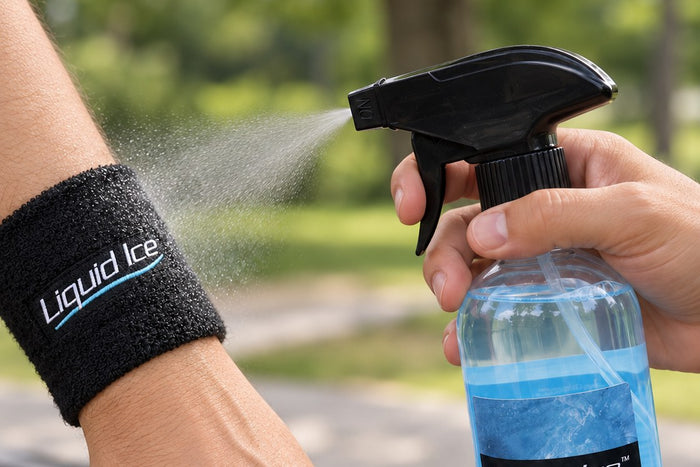
- At the arm: a sweatband on the wrist or forearm, soaked or sprayed generously.
- At the neck and upper body: spray the collar and a tight undershirt generously.
- At the helmet: a sweatband at the helmet rim. The more air gets in, the better it cools; under a closed, sealed helmet hardly anything evaporates.
Liquid Ice is worn exactly like this: on shirt, collar and band. As it evaporates, the liquid takes heat away from the skin. Sprayed onto a shirt, it cools as long as the fabric is damp. For teams, Liquid Ice comes in 25 litre canisters.
Checklist for the heat season
- Identify and assess the hazards from heat and UV radiation, including for employees at particular risk (§ 3).
- Set the programme of measures and involve employees (§ 4 (1) and (2)).
- Make the measures available to read, electronically or on paper (§ 4 (3)).
- Follow GeoSphere Austria’s heat warnings: from level 2, the measures apply (§ 4 (4)).
- Provide drinking water (§ 5 (1)) and UV-protective clothing (§ 5 (2)).
- Instruct employees: hazards, signs of heat-related symptoms, access to the heat warning, protective measures (§ 7).
Sources
- Hitzeschutzverordnung (Hitze-V), BGBl. II No. 325/2025, Austria’s federal legal information system, version of 14.10.2026: ris.bka.gv.at
- Skin temperature under the soaked bandage: Dermatest GmbH, Münster, 2008, 20 people. See the protocol
This page summarises the regulation and is not legal advice. The binding text is the one in Austria’s federal legal information system (RIS).
