
Heat protection plan template for employers: free to print
Print it, fill it in: responsibilities, triggers, measures, emergency, notice and briefing record. For Austria and Germany, free to use.
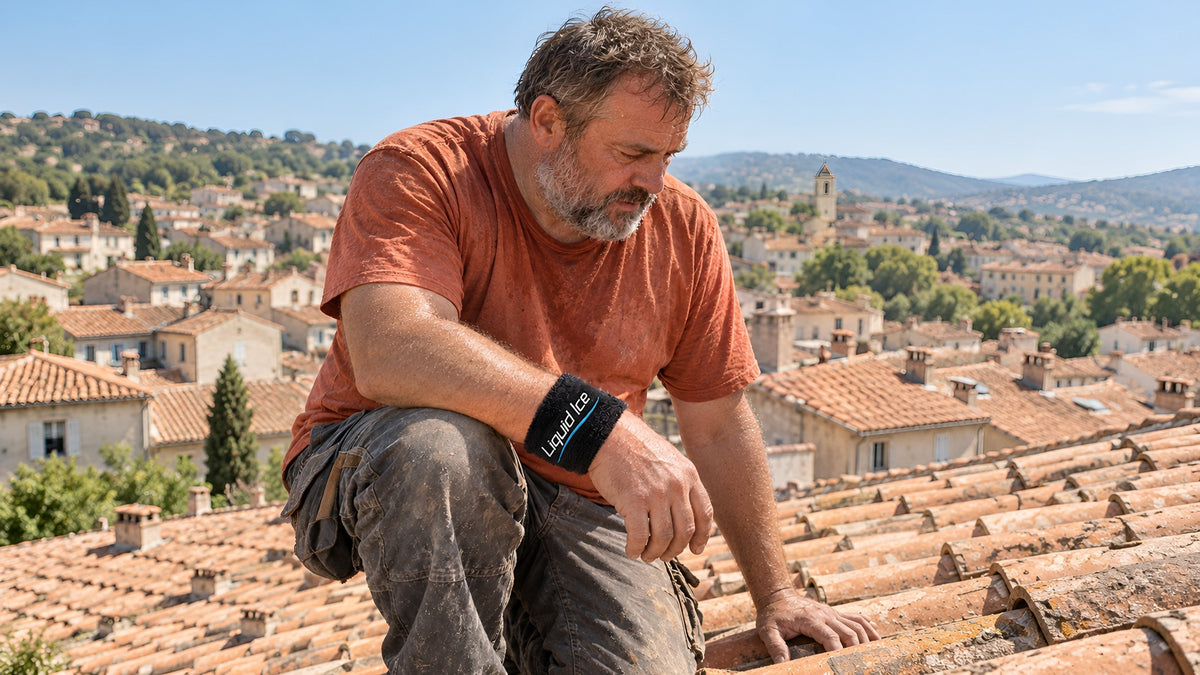
A heat protection plan sets out who does what in the heat: who checks the warning, which measures apply when, where water and shade are, and what happens in an emergency. Austria’s Heat Protection Ordinance requires this for outdoor work; in Germany it records the result of the risk assessment. Our free PDF template covers both.
Download the heat protection plan template (PDF, 6 A4 pages) · no sign-up · free to use · German version
Why a heat protection plan?
Heat is planned for in spring, not on the first hot day. If the plan says who fetches water, when the break is and who calls the ambulance, nobody has to argue about it on a warning day.
Austria: programme of measures under the Heat Protection Ordinance
Since 1 January 2026, the Heat Protection Ordinance (Hitzeschutzverordnung, Hitze-V, BGBl. II No. 325/2025) has applied to outdoor work at workplaces, on construction sites and at external work locations; work of short duration is exempt. Employers assess the hazards from heat and UV radiation (§ 3) and set a programme of measures including emergency measures (§ 4). The labour inspectorate calls this the heat protection plan. It must be accessible to all employees and to the labour inspectorate, on paper or electronically, email included. It applies as soon as GeoSphere Austria issues a heat warning of at least level 2 (yellow).
Germany: risk assessment, ASR A3.5 and the ASTA recommendation
Germany has no separate heat ordinance. Heat belongs in the risk assessment under § 5 of the Occupational Safety and Health Act (ArbSchG), and you document results and measures under § 6. Indoor workrooms are covered by ASR A3.5 “Room temperature”, outdoor workplaces by the recommendation of the Committee for Workplaces (ASTA) of 21.08.2025. It suggests making the results known to employees in good time, for example as a company heat protection plan.
What the law requires in detail is in our guide Heat protection at work and, for Austria, on the page Heat Protection Ordinance: what applies, what cools. This article is about the tool: the plan itself.
The template: 10 fields to fill in
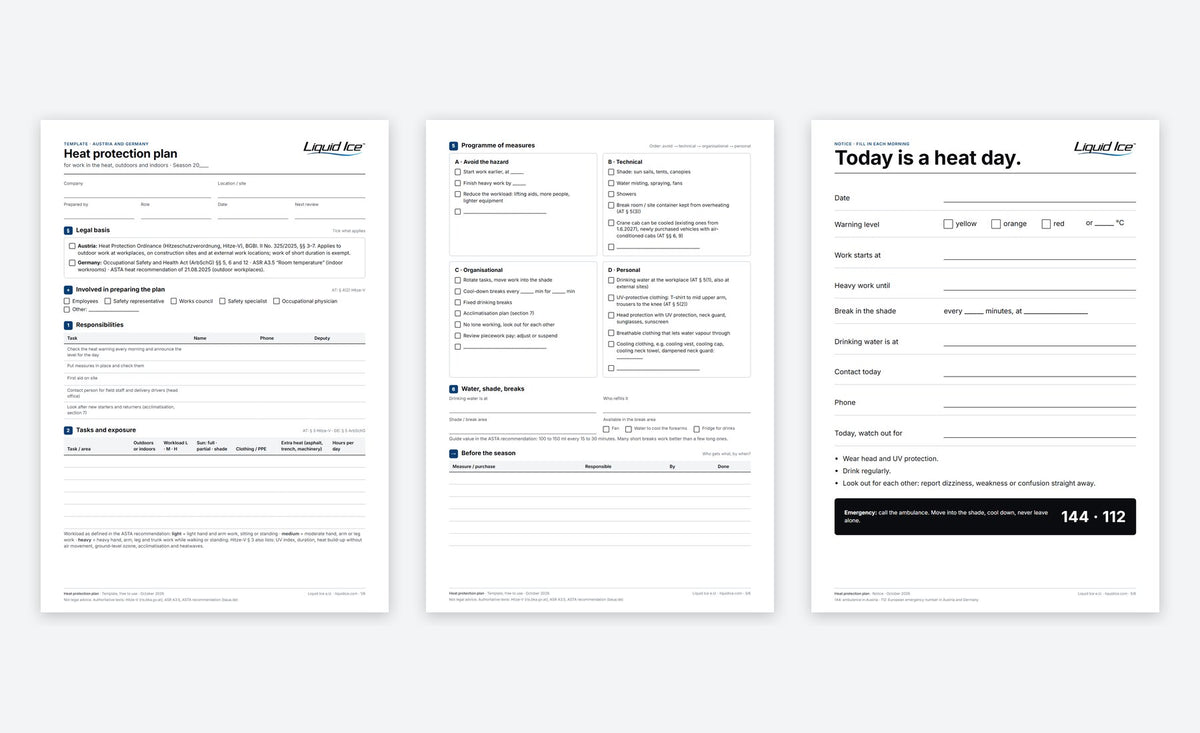
The template has six A4 pages: four pages of plan, a notice for heat days and a briefing record. Fill it in once before the season and put it up where your people will see it.
- Header and legal basis: company, location, season, who prepared the plan and who was involved. In Austria, employees must be involved in setting the measures (§ 4(2) Hitze-V).
- Responsibilities: who checks the heat warning every morning, who puts the measures in place, who gives first aid. For field staff and delivery drivers, a contact person at head office.
- Tasks and exposure: for each task, workload, sun or shade, clothing and PPE, extra heat such as asphalt or a trench, duration.
- Assessment temperature (Germany, outdoors): a calculation box following the ASTA recommendation, with every adjustment at a glance.
- Triggers and levels: what happens in your company at which warning level or temperature, plus a log for heat days.
- Programme of measures: four blocks in the prescribed order, with tick boxes and space for your own decisions.
- Water, shade, breaks: where the water is, who refills it, where the break area is, and who gets what by when.
- Acclimatisation and people at particular risk: a step plan for new starters and returners based on AUVA, with no health data in the plan.
- Emergency: emergency numbers, procedure, first aiders, access route for the ambulance.
- Accessible, briefed, reviewed: where the plan is posted, when the briefing took place and, after the summer, what worked.
The “Today is a heat day” notice
Page 5 is a notice for the site container, the gate or the warehouse. On the morning of a heat day, the person in charge fills in the warning level or assessment temperature, start time, break rhythm, where the water is, the contact person and the emergency numbers 144 and 112. Everyone sees at a glance what applies today.
Triggers: warning levels and temperature thresholds
A plan without triggers stays in the drawer. Decide what applies from when, and who announces it.
| Trigger | What applies | Source |
|---|---|---|
| Austria: GeoSphere Austria heat warning level 2 (yellow), felt temperature 30 to 34 °C | Put the programme of measures into effect (outdoor work) | § 4(4) Hitze-V, labour inspectorate |
| Austria: higher warning levels (orange, red) | Not regulated separately; the construction model assessment recommends stepping up measures by warning level | Labour inspectorate |
| Germany: above 26 °C | Measures should be taken, drinks should be available (indoors: air temperature, when it is above 26 °C outside and sun protection is in place; outdoors: assessment temperature) | ASR A3.5, ASTA recommendation |
| Germany: above 30 °C | Effective measures must be taken, technical and organisational before personal ones | ASR A3.5, ASTA recommendation |
| Germany: above 35 °C | Not suitable as a workplace without measures as for hot work | ASR A3.5, ASTA recommendation |
For indoor workrooms, ASR A3.5 is the standard. The ASTA document for outdoor work is a recommendation; unlike an ASR, it does not carry a presumption of conformity. Its assessment temperature adds up the load outdoors: air temperature plus 2 or 4 °C for medium or heavy work, plus 2 to 4 °C for protective clothing and PPE, plus 2 or 5 °C for sun, plus 3 °C for humidity, minus 2 or 3 °C for wind. So 28 °C in the shade becomes 37 °C for heavy work in full sun. You find the warnings themselves at GeoSphere Austria (per district, with a four-day outlook) and at the German Weather Service (DWD) (per county, from a felt temperature of about 32 °C).
Measures: technical, organisational, personal
Both countries set the order: avoid the hazard first, then technical, then organisational, personal last. The template has four blocks for this. The examples in it come from the ordinance, the labour inspectorate and the ASTA recommendation:
- Avoid the hazard: move working hours to the morning, reduce the workload.
- Technical: shade, water misting and spraying, fans, showers. In Austria also: site containers must not overheat (§ 5(3)), crane cabs must be coolable, existing ones from 1 June 2027, and newly purchased self-propelled equipment on construction sites needs an air-conditioned cab (§§ 6 and 9).
- Organisational: task rotation, moving work into the shade, acclimatisation, cool-down breaks. According to the ASTA recommendation, many short breaks work better than a few long ones.
- Personal: drinking water, UV-protective clothing and head protection, neck guard, sunglasses, cooling clothing. The labour inspectorate gives cooling vests, cooling caps and cooling neck towels as examples; the ASTA recommendation lists headwear with a dampened neck guard.
In Austria, two personal measures are explicitly mandatory: drinking water at external work locations too (§ 5(1)) and UV-protective clothing, at least a T-shirt to the middle of the upper arm and trousers to the knee (§ 5(2)). As a guide for drinking, the ASTA recommendation gives 100 to 150 ml every 15 to 30 minutes. Which cooling clothing does what is explained in our guide Cooling clothing.
Where Liquid Ice fits in
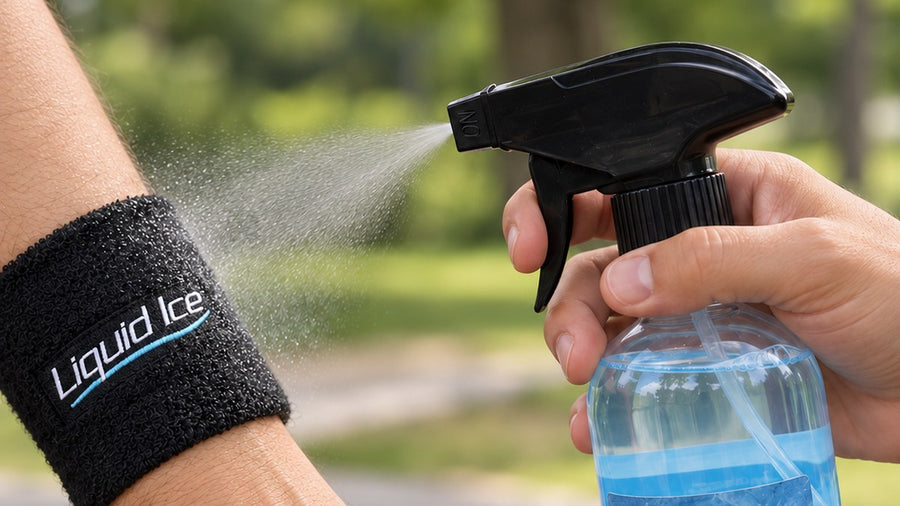
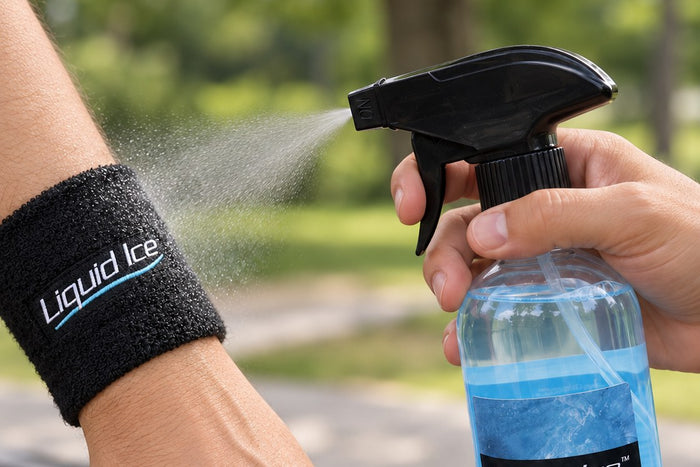
Liquid Ice is a cooling liquid for the personal measures. Your people spray it from the 500 ml bottle with pump sprayer onto a tight-fitting shirt, the collar or a sweatband; as it evaporates, it takes heat away from the skin. No power, no ice, the bottle is stored at room temperature. Measured on the soaked bandage: 5.8 °C cooler skin, and after two hours it is still cooling. Liquid Ice does not replace shade, water or breaks, and no single product satisfies the ordinance. Because it contains alcohol, it does not belong near welding, flame or asphalt work.
A 10-minute briefing for the crew
In Austria, the briefing must cover at least five points (§ 7 Hitze-V). In Germany, § 12 ArbSchG requires a briefing tailored to the workplace. A ten-minute run-through before the season:
- Minutes 0 to 2, why: heat and UV radiation in outdoor work; what is in the plan and where it is posted.
- Minutes 2 to 4, warning signs: AUVA lists, for example, light-headedness, weakness and exhaustion, and dizziness. Anyone who notices this in themselves or others reports it straight away.
- Minutes 4 to 6, the warning: where GeoSphere Austria or the DWD issues warnings, where to find the UV index, who announces the level in the morning.
- Minutes 6 to 8, heat day: start time, break rhythm, water, head and UV protection, cooling clothing.
- Minutes 8 to 10, emergency: emergency number, procedure, first aiders, where the first aid kit is. In Austria also: the note on the voluntary health check for UV exposure.
Have attendance signed on page 6 of the template.
Season start checklist for April
- Read last year’s plan and review: what worked, what didn’t?
- Name the people responsible and their deputies for the summer.
- Check sun sails, tents, water containers, fans and first aid kits; order what is missing.
- Have UV-protective clothing and head protection ready in the right sizes.
- Choose cooling clothing and try it out before the first hot day.
- Prepare the acclimatisation plan for new and seasonal workers.
- Bookmark the GeoSphere Austria and DWD warning pages; DWD heat warnings are also available as a newsletter.
- Schedule the briefing; post the plan or email it to everyone.
Common questions about the heat protection plan template
Does the heat protection plan have to be in writing?
In Austria, the programme of measures must be accessible to all employees and to the labour inspectorate, on paper or electronically (§ 4(3) Hitze-V). In Germany, you need records showing the risk assessment, the measures and how they were checked (§ 6 ArbSchG).
Does the template replace the risk assessment?
No. The template records the result and makes it visible. For the assessment itself there are official aids: in Austria the labour inspectorate’s checklist and construction model assessment and the AUVA leaflet M.plus 012; in Germany the ASTA recommendation, which also points to model documents from BG BAU.
Can I change the template and pass it on?
Yes. Adapt the fields, delete what does not apply to you, and pass the template on to subcontractors or clients. Where employees of several employers work on one site, in Austria they must coordinate their measures (§ 4(5) Hitze-V).
Does the Heat Protection Ordinance apply in offices and halls?
No, it applies to outdoor work. For indoor workrooms, the indoor climate rules apply in Austria and ASR A3.5 in Germany. That is why the template has room for both: outdoor and indoor tasks.
What belongs in the heat emergency plan?
According to AUVA and the ASTA recommendation: call the ambulance (144 in Austria, European emergency number 112), move the person into the shade or a cool room, remove heavy clothing, cool actively, for example with cold water and wet cloths, give them something to drink if they are conscious, and never leave them alone. In case of confusion, slurred speech or unconsciousness, call the emergency number at once. If the person is unconscious and not breathing normally, start resuscitation immediately.
Cooling for your crew
For teams, Liquid Ice comes in a 25-litre canister for refilling the bottles. Tell us how many people work in the heat at your company: we call you, send samples on request and the terms in writing after the call. Book a callback
Sources
- Heat Protection Ordinance (Hitze-V), BGBl. II No. 325/2025, Austrian Legal Information System (RIS)
- Austrian labour inspectorate: Arbeiten bei Hitze im Freien and Kommentierte Hitzeschutzverordnung (German)
- AUVA leaflet M.plus 012 “Arbeiten im Freien bei Hitze”, April 2026 (German)
- Arbeitsschutzgesetz § 5, § 6 and § 12
- ASR A3.5 “Raumtemperatur”, BAuA
- ASTA recommendation on heat at outdoor workplaces, adopted 21.08.2025, BAuA
- German Weather Service: Hitzewarnung
- Skin temperature on the soaked bandage: Dermatest GmbH, Münster, 2008, 20 people, see the protocol
This page and the template are a working aid, not legal advice. The authoritative texts are those in the RIS and at BAuA. As of October 2026.