

Knee cooling wrap: how to wrap it, cool and compress
A knee cooling wrap is an elastic bandage that cools the knee while sitting firmly around the joint. There are three common ways to cool a knee at home: a gel cuff chilled in the fridge, ice or a cold pack wrapped in a cloth, or a bandage soaked in a cooling liquid. Below you can compare the three and learn how to wrap a knee properly with the Liquid Ice bandage.
What is a cold compression wrap for the knee?
It is any wrap that cools the knee and presses on it at the same time. Here is how the three home options differ.
Gel cuff
A gel cuff is wrapped around the knee and has to be chilled first, as the pack instructions describe. Like any cold pack, it should not sit directly on bare skin.
Ice wrap: ice or a cold pack in a towel
Ice, a cold pack or a bag of frozen peas wrapped in a tea towel, as the NHS describes. An NHS trust leaflet on knee injuries advises a damp towel between the ice and your skin to avoid ice burns. To keep it in place on the knee you need a second bandage or a free hand.
A bandage soaked in cooling liquid
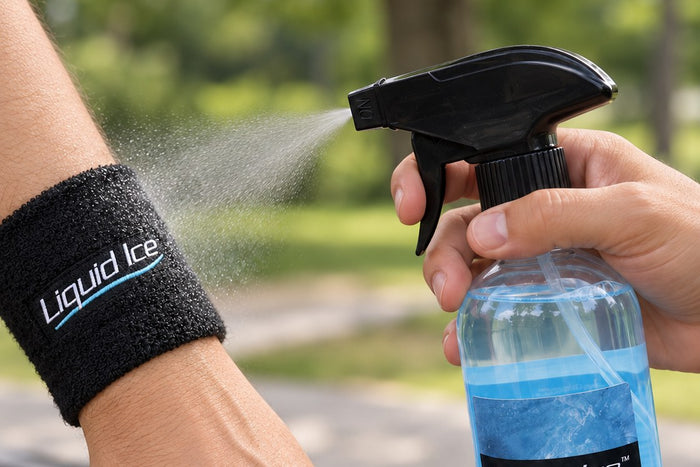
Here the cooling comes from the bandage itself. Liquid Ice, the original since 1998, is a cooling liquid made of water, denatured ethanol, menthol and camphor that cools the skin as it evaporates. The elastic bandage is soaked in it and wrapped firmly, which gives you cooling and compression in one bandage, with no freezer, no ice and no power. The can and bandage are stored at room temperature.
Gel cuff, ice pack or soaked bandage compared
| Gel cuff | Ice or cold pack in a towel | Soaked bandage (Liquid Ice) | |
|---|---|---|---|
| Preparation | Chill in advance as the pack instructions say | Take ice or a pack from the freezer, wrap it in a towel | Soak in the can, wring out over the can |
| Fridge or freezer needed | Yes | Yes | No, stored at room temperature |
| Compression | Depends on the model | Only with an extra bandage | Yes, from the firmly wrapped bandage |
| One application | As for any cold pack: first-aid sources give 10 to 20 minutes at a time, then a break | Up to 20 minutes every 2 to 3 hours (NHS) | Stays on; when dry, soak it again (see the measurement below) |
Cooling machines with a hose and cuff are a fourth option. All four are compared on Cooling bandages: four types compared, and bandage, ice and machine side by side on Cooling compared.
How to wrap a knee, step by step
This is how to put the Self Cooling Bandage on a knee. The basic rules for elastic bandages come from first-aid training: firm but not so tight that it restricts circulation, spiral turns, each layer overlapping the last.

- Sit down. Sit comfortably with the leg supported.
- Soak. Soak the bandage in the can until it is properly wet.
- Wring. Wring it out over the can so the spare Liquid Ice runs back in. The bandage should be moist, not dripping.
- Start below the knee. Wrap once around just below the knee to anchor the end.
- Spiral upwards. Wrap in spiral turns up over the knee, each turn slightly overlapping the one before.
- Firm, not tight. Keep an even, firm pull. The bandage should sit snugly without cutting in.
- Tuck the end in. Tuck the end firmly under the last turn at the top. Do not cover or tape the bandage; it needs air.
Is the bandage too tight?
Check straight after wrapping and again regularly; St John Ambulance advises checking circulation every 10 minutes. The bandage is too tight if:
- your lower leg or foot tingles or goes numb,
- the skin below the bandage turns pale or blue or feels cold,
- the lower leg below the bandage starts to swell.
A quick check is the nail test: press on a toenail for five seconds until it goes pale. If the colour does not come back within two seconds, the bandage is too tight. Unwrap it and put it on again more loosely.
Active Ice Bandage: already soaked in a pouch

The Active Ice Bandage comes ready-soaked in a pouch. Tear the pouch open, wring the bandage out over it and wrap it just as firmly as described above. To re-soak it, add about 50 ml of Liquid Ice to the pouch. See the Active Ice Bandage
How long should you cool a knee?
The timings in first-aid advice refer to ice and cold packs. The NHS says up to 20 minutes every 2 to 3 hours; an NHS trust leaflet on knee injuries suggests crushed ice in a damp towel for 10 to 15 minutes, several times a day. Why the advice varies is explained in How long to ice an injury.
The Liquid Ice bandage cools by evaporation. Measured on the soaked bandage: 5.8 °C cooler skin, and still cooling after two hours. The measurement was taken by Dermatest in Münster in 2008 on 20 people using infrared; read about the measurement. When the bandage is dry, dip it back in the can, wring it out and wrap it again. Washing at 30 °C restores its full stretch.
See the Self Cooling Bandage (can and bandage)
When not to wrap, and when to see a doctor
- Not on open wounds, fresh scars or irritated skin. Keep Liquid Ice away from your eyes.
- In winter, the soaked bandage stays in the can outdoors in sub-zero temperatures and wind, because a wet bandage can chill the skin too much there. Put it on indoors: at home, in the mountain hut, in your accommodation or in the car.
- Call 999 (112 elsewhere in Europe) or go to A&E if you heard a crack when you were injured, the joint has changed shape, the leg or foot is numb or tingling, or the skin looks blue or grey or feels cold.
- Get advice from NHS 111 or a doctor if you cannot put weight on the leg, the swelling is large or getting worse, the knee gives way or locks, or the pain is getting worse.
After a fall on the slopes, read Ski knee injury: what to do in the first hour.
This page does not replace a medical examination.
Sources
- Sprains and strains. NHS. nhs.uk
- Knee pain. NHS. nhs.uk
- Traumatic knee injury. East Lancashire Hospitals NHS Trust. elht.nhs.uk
- How to put on a bandage. St John Ambulance. sja.org.uk
- First Aid: Bandaging. UMass Memorial Health. ummhealth.org
- Dressings and bandages. St John New Zealand. stjohn.org.nz
- Das Handbuch für alle Rotkreuzkurse (Red Cross first-aid handbook), chapter on wounds and bandages. Deutsches Rotes Kreuz (DRK). drk-intern.de
- Erste-Hilfe-Maßnahmen bei Sportverletzungen (first aid for sports injuries). Malteser Hilfsdienst. malteser.de
Fragen? Schreib uns: hello@liquidice.com